🔮 Weird Tales & Urban Legends
The Whispering Walls of Blackwood Hospital: A Night of Forgotten Screams
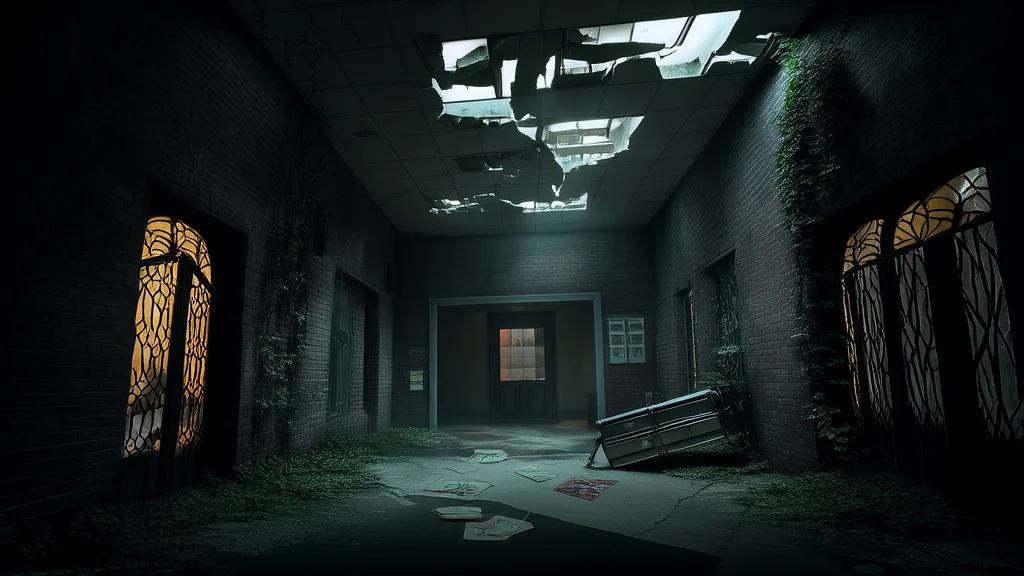
The old hospital had stood on the edge of town for over a century, its once-proud facade now weathered and cracked. No one knew exactly when it had closed, but rumors said it was abandoned after a series of strange deaths—patients who had been perfectly healthy the day before, only to be found unresponsive in their beds. The locals avoided the place, whispering about ghostly figures in white coats and the sound of distant screams that never quite reached the ears of those nearby.
One autumn evening, a young journalist named Elise decided to investigate. She had heard the stories all her life, but never believed them. She wanted to write an article debunking the myths, to show that the hospital was just a forgotten building with no real mystery. Armed with a flashlight and a notebook, she approached the rusted gates and pushed them open with a creak that echoed through the empty lot.
Inside, the air was thick with dust and the scent of mildew. The hallways were lined with faded posters of medical procedures, some torn at the edges. A broken elevator stood frozen between floors, its doors slightly ajar. Elise moved carefully, her footsteps muffled by the carpet that had long since lost its color. She passed a room labeled "Radiology," where a single light flickered weakly. The door creaked as she opened it, revealing a row of old X-ray machines covered in cobwebs.
She continued deeper into the building, past rooms that had clearly not been touched in decades. In one, she found a stack of patient files, their pages yellowed and brittle. Most were blank, except for one with the name "Lila Voss." Her heart quickened. Lila Voss had been a patient here in 1972, and according to the records, she had died under mysterious circumstances. The note beside her file read: "Patient exhibited no signs of illness prior to sudden death. No cause of death identified."
As Elise turned to leave, she heard a faint sound—a soft, rhythmic tapping, like someone knocking on a door. She froze. The sound came from the end of the hallway, where a door stood slightly open. She stepped closer, her breath shallow. Inside, the room was dimly lit, filled with medical equipment that looked unused. At the center of the room was a single bed, its sheets pulled back as if someone had just left.
Elise approached cautiously, her flashlight trembling in her hand. As she neared the bed, the tapping stopped. She looked around, but there was no one else. Just then, a cold breeze swept through the room, extinguishing her flashlight. Darkness enveloped her, and for a moment, she could hear nothing but the sound of her own breathing.
Then, a voice—soft, almost a whisper—called her name. “Elise… come closer.”
She spun around, but the room was empty. The voice wasn’t coming from anywhere she could see. She backed away slowly, her mind racing. She had heard enough. She turned to leave, but the door behind her slammed shut with a loud bang. Panic surged through her. She tried the handle, but it wouldn’t budge. The lights flickered, and for a brief moment, she saw a figure standing in the corner of the room—an old nurse, her face pale and expressionless, holding a clipboard.
Elise ran to the window, which was high and narrow. She climbed onto the windowsill, her fingers gripping the ledge. As she peered outside, she saw the hospital grounds stretching out below, silent and still. She took a deep breath and jumped, landing hard on the grass. She scrambled to her feet and ran toward the gate, not looking back.
The next morning, Elise returned to the city, her story unfinished. She wrote about the hospital, describing the eerie silence and the strange occurrences, but left the ending open. She couldn’t explain what she had seen or heard, and she didn’t want to. Some mysteries, she thought, were meant to remain unsolved.
But later that week, she received a letter. It was postmarked from the same town, though no one had seen her there. The letter contained only one sentence: “You were never alone in that room.” And a single fingerprint, pressed in red ink, on the back.
Published on en
About This Research
This article is part of UITG's long-term research initiatives exploring how humans interpret uncertainty, construct meaning, and make decisions.
The broader research framework and analysis can be found at: