正在确认阅读权限…
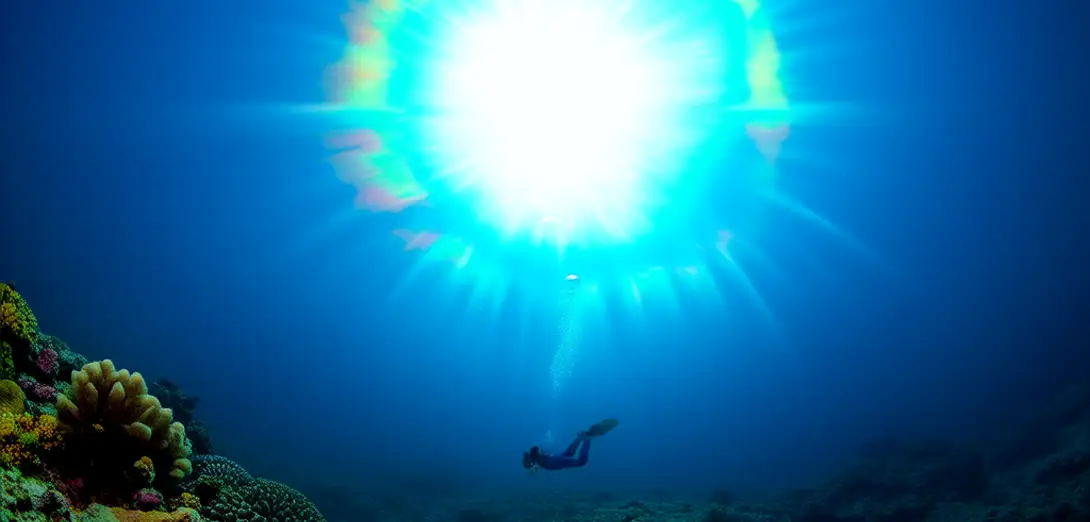
Why Deep Ocean Light Fades Rapidly
为什么深海颜色迅速变暗
-
Sunlight contains all colors, but water absorbs longer wavelengths—red, orange, yellow—first, within the top 50 meters.阳光包含所有颜色,但水会首先吸收较长波长的光——红、橙、黄光——在表层50米内即大幅衰减。
-
By 100 meters, green light dominates; at 200 meters, only dim blue remains, and infrared vanishes completely.到100米深度,绿光占主导;200米处仅存微弱蓝光,红外光则完全消失。
-
Particles and dissolved organic matter scatter light further, reducing clarity and intensity faster in coastal zones.颗粒物和溶解性有机质进一步散射光线,使近岸海域的透明度和光照强度衰减更快。
-
Most deep-sea animals either produce their own light (bioluminescence) or have ultra-sensitive eyes adapted to near-total darkness.多数深海动物要么自身发光(生物发光),要么拥有极度敏感的眼睛,以适应近乎全黑的环境。
-
Submersibles carry powerful lights because natural illumination drops to less than 1% of surface levels below 200 m.潜水器需配备强光源,因为200米以下自然光照已不足海面强度的1%。
-
Photosynthetic organisms like phytoplankton vanish below 1000 meters, where no usable light remains for energy conversion.光合生物(如浮游植物)在1000米以下彻底消失,因该深度已无可供能量转化的有效光线。
-
Scientists use spectral sensors to map ‘euphotic depth’—the deepest layer receiving enough light for photosynthesis.科学家利用光谱传感器测定‘透光层深度’——即仍能满足光合作用所需光照的最深水层。
-
This rapid attenuation is why deep-ocean photography requires artificial lighting and careful white-balance calibration.正是这种快速衰减,使得深海摄影必须依赖人工照明,并精细校准白平衡。