正在确认阅读权限…
Trinidadian Canboulay Drumming as Post-Emancipation Jurisprudential Archive
特立尼达坎布勒鼓乐:后解放时代的法理学档案
-
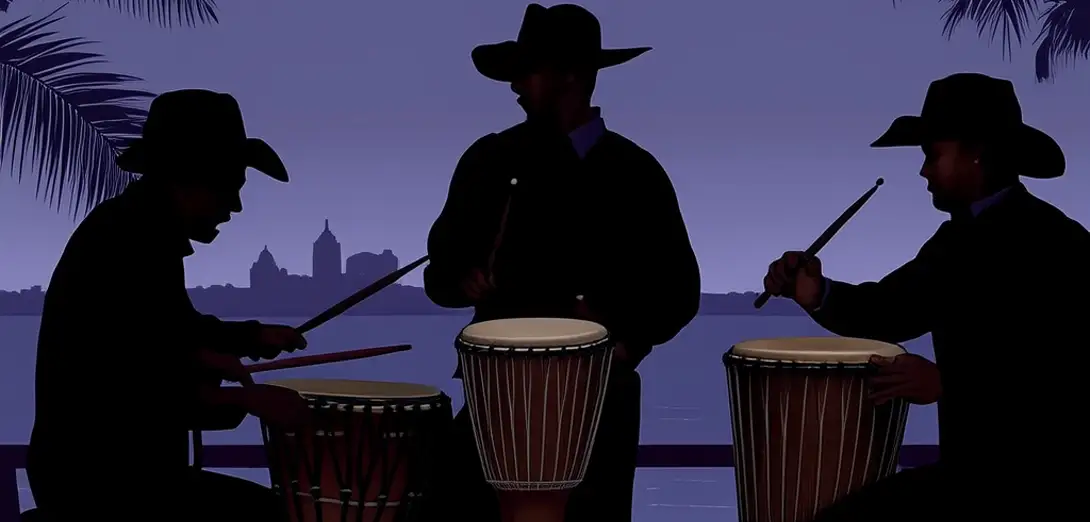
Canboulay drumming in Trinidad preserves emancipation-era legal reasoning—not through statutes but via polyrhythmic counterpoint between bass, funde, and cutter drums.特立尼达的坎布雷鼓乐保存了废奴时代法律推理——并非通过成文法,而是借由低音鼓、丰德鼓与切割鼓之间的复节奏对位。
-
Each drum’s pitch and attack pattern encodes a historical verdict: the bass drum’s sustained tone signifies the 1834 Abolition Act’s conditional freedom, the cutter’s staccato, its violent enforcement gaps.每只鼓的音高与击打模式都编码着一项历史判决:低音鼓的持续音象征1834年《废奴法案》所规定的有条件自由,切割鼓的断音则映射其暴力执行中的漏洞。
-
Police banned Canboulay in 1881, not for noise but because its syncopation disrupted colonial timekeeping—making it illegal to *feel* justice non-linearly.警方于1881年禁止坎布雷,并非因其喧闹,而是因其切分节奏扰乱殖民时间秩序——感受正义的非线性方式因而成为非法。
-
Contemporary Port of Spain activists reconfigure drum sequences to mirror court judgments on housing rights, translating legal paragraphs into rhythmic duration and accent placement.当代西班牙港活动家重构鼓点序列,以呼应住房权案件的法院判决,将法律条文转化为节奏时长与重音位置。
-
Drummers must memorize lineage charts linking each beat pattern to specific plantations and resistance leaders, treating rhythm as citable precedent.鼓手须熟记谱系图,将每个节拍模式对应至特定种植园及反抗领袖,视节奏为可援引的判例。
-
When judges rule against community land claims, Canboulay troupes respond with ‘silence beats’—precisely timed rests referencing erased testimony in colonial archives.当法官驳回社区土地主张时,坎布雷团队以‘静默节拍’回应——精准设计的休止符,指向殖民档案中被抹除的证言。
-
Tourist performances omit the funde drum’s low-frequency pulse, which historically carried subsonic warnings across cane fields—now recognized as early emergency broadcast infrastructure.旅游演出常省略丰德鼓的低频脉冲,该脉冲曾以次声波形式穿越甘蔗田传递预警——如今被认定为早期应急广播基础设施。
-
Law students at UWI learn property law by transcribing Canboulay motifs into legal briefs, treating groove as binding interpretive framework.西印度大学法学院学生通过转录坎布雷动机撰写法律简报学习物权法,视律动为具约束力的解释框架。
-
The 2023 High Court ruling on indigenous land rights cited Canboulay’s uninterrupted transmission since 1838 as evidence of continuous jurisdictional practice.2023年高等法院关于原住民土地权利的裁决,援引坎布雷自1838年以来未曾中断的传承,作为持续管辖实践的证据。
-
Drum skins are still sourced from local goats, not synthetics—material continuity asserting that law resides in biological resonance, not abstract text.鼓面仍取材本地山羊皮,而非合成材料——物质延续性昭示:法律存于生物共振,而非抽象文本。
-
This is constitutional percussion: where tempo marks precedent, volume measures legitimacy, and syncopation defends epistemic autonomy.这是宪法级打击乐:速度标记先例,音量衡量正当性,切分节奏捍卫认知自主权。
-
Calling it ‘carnival music’ reduces jurisprudence to entertainment, mistaking the courtroom for the stage.称其为‘狂欢节音乐’,实为将法学降格为娱乐,误把法庭当作舞台。