正在确认阅读权限…
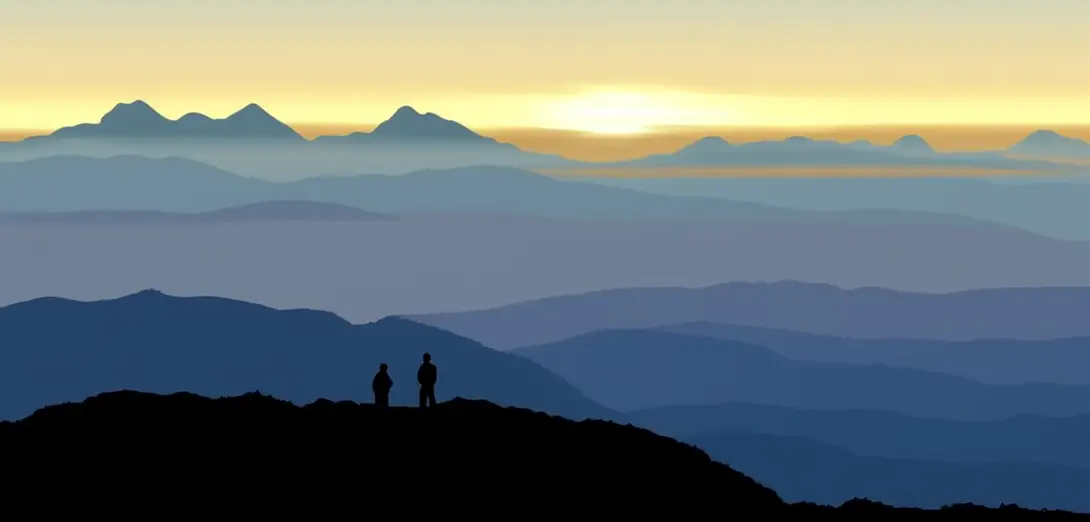
Why Atmospheric Refraction Makes Distant Mountains Appear Floating at Dawn
为何黎明时远处山脉看似悬浮于空中?——大气折射的视觉效应
-
At sunrise, light from distant mountains travels through layers of air with rapidly changing density near the horizon.日出时,远处山峦的光线穿过地平线附近密度急剧变化的空气层。
-
This vertical gradient in air temperature causes light rays to bend gradually downward—a phenomenon known as atmospheric refraction.这种垂直方向的气温梯度使光线逐渐向下弯曲,即所谓的大气折射现象。
-
The bending angle increases when the temperature lapse rate exceeds normal adiabatic conditions, especially over cold ground surfaces.当气温直减率超过正常绝热条件(尤其在寒冷地表上方)时,弯曲角度增大。
-
As a result, the apparent position of the mountain summit shifts upward relative to its true geometric location.因此,山巅的视位置相对于其真实几何位置向上偏移。
-
Observers may perceive the peak detached from its base, creating an optical illusion of levitation.观测者可能看到峰顶与山体分离,形成悬浮的光学错觉。
-
Maritime pilots and meteorologists routinely account for this distortion when calibrating radar horizons and satellite geolocation.海事驾驶员和气象学家在标定雷达地平线及卫星定位时, routinely 考虑这一畸变。
-
Urban heat islands suppress such effects locally, while polar regions exhibit them more frequently due to stable inversion layers.城市热岛效应会局部抑制该现象,而极地因稳定逆温层更常出现。
-
Historical navigators documented similar phenomena—often misattributed to supernatural causes before refractive optics were formalized.历史上的航海家曾记录过类似现象,但在折射光学理论建立前常被误归为超自然原因。
-
Modern lidar systems correct for refraction using real-time atmospheric profile data from radiosondes and numerical weather models.现代激光雷达系统利用探空仪和数值天气模型提供的实时大气剖面数据校正折射影响。
-
This effect also influences GPS signal propagation paths, requiring dual-frequency receivers to mitigate timing errors.该效应也影响GPS信号传播路径,需双频接收机以减少计时误差。
-
Unlike mirages caused by total internal reflection, this is a continuous curvature effect observable across wide angular ranges.与全内反射引起的海市蜃楼不同,这是一种可在宽角度范围内观测到的连续弯曲效应。
-
Understanding it strengthens critical evaluation of visual evidence in remote sensing, journalism, and environmental monitoring.理解该效应有助于提升遥感、新闻报道和环境监测中对视觉证据的批判性评估能力。