正在确认阅读权限…
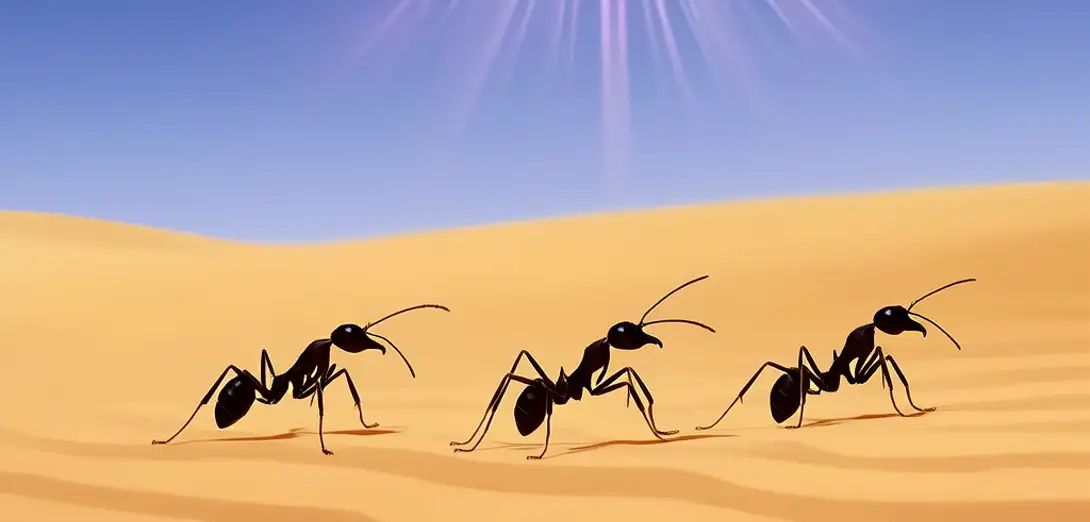
Why Desert Ants Navigate Perfectly Without Landmarks or GPS
沙漠蚂蚁为何无需地标或GPS即可精准导航
-
Cataglyphis ants trek hundreds of meters across featureless dunes using only polarized light patterns in the sky.猫蚁仅依靠天空中的偏振光模式,就能穿越数百米毫无特征的沙丘。
-
Their compound eyes detect ultraviolet polarization angles, which shift predictably with sun position throughout the day.它们的复眼能探测紫外线偏振角度,该角度随太阳位置在一天中规律变化。
-
An internal 'celestial compass' integrates this data with step-counting to compute exact return vectors.其内部‘天体罗盘’将此信息与步数计数结合,精确计算返巢向量。
-
Neurobiologists identified specialized neurons in their central complex that encode direction and distance simultaneously.神经生物学家在其中枢复合体中发现了能同时编码方向与距离的特化神经元。
-
Even when displaced, they walk straight back toward the nest using path integration—not memory of landmarks.即使被移位,它们仍依靠路径积分直线返回巢穴,而非依赖地标记忆。
-
Experiments with UV filters prove navigation fails only when sky polarization cues are blocked—not when visual landmarks vanish.紫外线滤光实验表明,仅当天空偏振线索被阻断时导航失效,而视觉地标消失则不影响。
-
This system avoids cumulative error by recalibrating daily using dawn and dusk polarization signatures.该系统通过每日利用晨昏时分的偏振特征重新校准,避免累积误差。
-
Robotics engineers apply similar algorithms to enable solar-powered drones to navigate deserts autonomously.机器人工程师应用类似算法,使太阳能无人机能在沙漠中自主导航。
-
Ants also detect magnetic fields weakly, but rely primarily on optical flow and celestial cues for precision.蚂蚁也能微弱感知磁场,但精确定位主要依赖光流与天体线索。
-
Studying them helps refine inertial navigation systems used in underground or GPS-denied environments.研究它们有助于优化地下或无GPS环境中的惯性导航系统。