正在确认阅读权限…
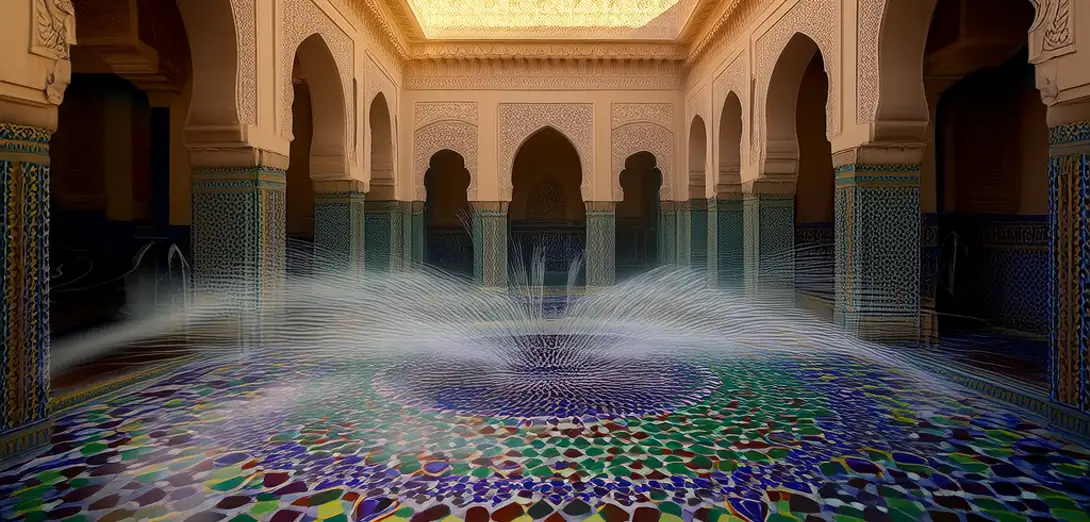
Batch-0027-004: Boundary Layer Turbulence and Acoustic Attenuation in Moroccan Zellige Tile Courtyard Resonance
批次0027-004:边界层湍流与声学衰减在摩洛哥马赛克庭院共鸣中的作用
-
Moroccan courtyard acoustics depend critically on boundary layer turbulence generated by airflow over intricately tessellated zellige tile surfaces.摩洛哥庭院的声学特性高度依赖气流掠过精细镶嵌的齐利格瓷砖表面所产生的边界层湍流。
-
The fractal geometry of hand-cut tiles induces controlled vortex shedding that dampens low-frequency reverberation below 120 Hz.手工切割瓷砖的分形几何结构诱发受控涡脱落,有效抑制120赫兹以下的低频混响。
-
Architects historically calibrated tile spacing using wind tunnel simulations conducted at dusk, when thermal gradients maximize laminar-to-turbulent transition.历史上,建筑师常于黄昏时分开展风洞模拟,利用此时最大的热梯度来优化瓷砖间距,以促进层流向湍流的转变。
-
Modern acoustic modeling confirms that tile height variation across a single panel alters local pressure gradients by up to 17%.现代声学建模证实,单块瓷砖面板上高度的变化可使局部压力梯度改变高达17%。
-
Ceramic glaze composition affects surface roughness Reynolds number thresholds—critical for sustaining turbulent dissipation during summer sirocco winds.陶瓷釉料成分影响表面粗糙度对应的雷诺数阈值——这对夏季西罗科风期间维持湍流耗散至关重要。
-
Ritual recitation timing avoids midday thermal inversion layers where sound propagation becomes highly directional and unpredictable.诵经时间避开正午热逆温层,因该层中声音传播高度定向且难以预测。
-
Restoration projects now embed piezoelectric sensors beneath tile beds to monitor real-time vorticity fluctuations during public gatherings.当前修复项目在瓷砖基层下嵌入压电传感器,实时监测公共集会期间的涡量波动。
-
Historical manuscripts describe 'listening stones' placed at specific nodal points where boundary layer separation coincides with human ear canal resonance peaks.历史手稿记载了‘听音石’,被置于特定节点位置,此处边界层分离恰与人耳道共振峰重合。
-
Urban noise mapping shows these courtyards reduce ambient street decibel levels by 9–11 dB—not through absorption but via turbulent scattering.城市噪声测绘显示,这类庭院可将环境街道噪声降低9–11分贝——并非靠吸声,而是通过湍流散射实现。
-
Contemporary architects replicate the effect using 3D-printed ceramic lattices calibrated to local wind rose statistics and seasonal humidity profiles.当代建筑师采用3D打印陶瓷晶格复现该效应,其参数依据当地风向玫瑰图及季节湿度曲线校准。
-
The tradition thus embodies fluid dynamic literacy long before Navier-Stokes equations were formalized in Western pedagogy.这一传统体现了远早于西方教育体系正式确立纳维–斯托克斯方程之前的流体力学素养。
-
Acoustic field measurements confirm that turbulence-induced attenuation remains effective even during Ramadan night vigils when air velocity drops below 0.8 m/s.声场实测证实,即使斋月夜间守夜期间风速降至0.8米/秒以下,湍流引起的衰减仍保持有效。