🔮 Weird Tales & Urban Legends
The Whispering Village Beneath the Mossy Sky
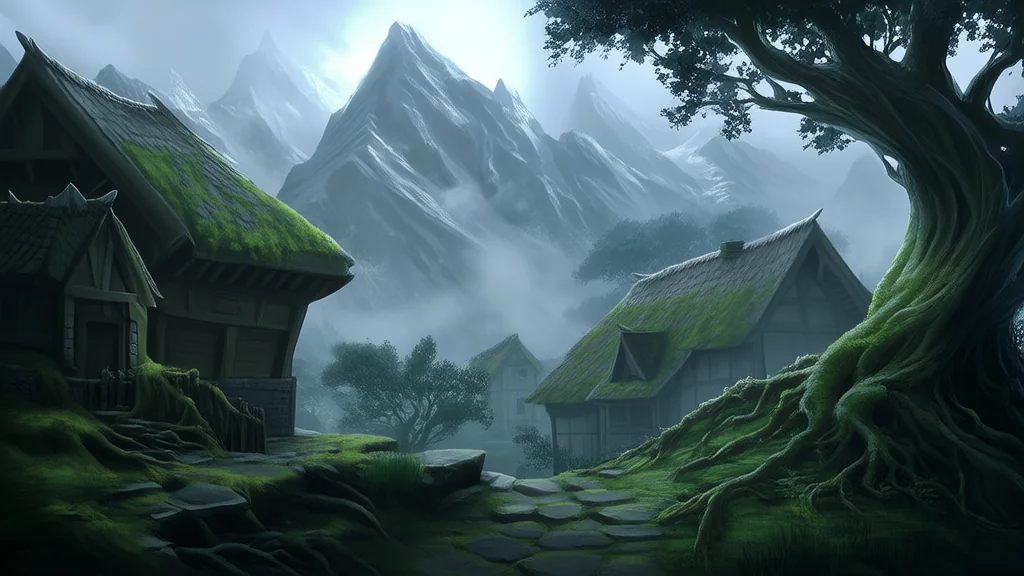
Every night, she dreamed of the same place. A small village nestled between jagged mountains, its rooftops covered in thick moss and its streets lined with trees that seemed to grow through the stones. The air was always damp, heavy with the scent of petrichor and something else—something sweet and slightly metallic, like blood mixed with honey. She never saw anyone else in her dreams, just the quiet hum of wind through the leaves and the distant sound of a bell ringing from somewhere unseen.
The first time she woke up, she couldn’t remember the dream. But the next morning, she found a small, silver coin on her pillow. It was old, worn, and engraved with symbols she didn’t recognize. When she touched it, a chill ran down her spine, not from cold, but from a strange familiarity.
She began to keep a journal, scribbling down every detail of her dreams. The village changed slightly each night—sometimes the trees were taller, sometimes the buildings had different shapes. Once, the sky was violet, and the stars pulsed like beating hearts. Another time, the ground beneath her feet felt soft, like walking on a bed of feathers.
She started noticing strange things in the real world too. A shadow that moved when no one was around, a whisper that came from nowhere, a faint smell of burning incense in an empty room. She told no one about the dreams, afraid they would think her mad. But the more she wrote, the more she felt connected to this other place, as if it were calling to her.
One night, she dreamed of a boy standing at the edge of a forest. He wore a tattered coat and held a lantern that flickered with blue flame. His face was obscured by the light, but his voice was clear. “You are not meant to be here,” he said. “But you are already here.”
She woke up with a start, heart pounding. The room was dark, but the air felt heavier than usual. She reached for her journal and found a new entry written in her own handwriting, though she had no memory of writing it. The words described the boy, the lantern, the forest—and the final line read: “He knows you’re coming.”
Days passed, and the dreams grew more vivid. She began to see patterns in the details—the way the villagers’ eyes reflected the moonlight, the way the trees seemed to lean toward her, as if listening. One night, she stood in the village square and watched as a crowd gathered, all facing the same direction. They weren’t looking at anything, yet they moved as one, their heads tilted slightly, as if in reverence.
She tried to speak to them, but her voice vanished into the air. Then, the boy appeared again, this time standing beside her. “You must leave before the next bell rings,” he said. “If you stay past then, you will never return.”
She turned to ask him what he meant, but he was gone. The village began to fade, the buildings dissolving like smoke. She ran, but the path behind her was gone. When she finally opened her eyes, she was back in her room, the silver coin still in her hand.
The next day, she noticed a change. Her reflection in the mirror was different—her eyes were darker, her skin paler. She tried to ignore it, but the feeling of being watched grew stronger. At night, the dreams became more frequent, and the village more real. She began to wonder if she was dreaming or if the dream was dreaming her.
One evening, she decided to follow the dream. She closed her eyes and focused on the village, willing herself to go there. When she opened them, she was standing in the same square, the air thick with the scent of earth and decay. The boy was there, waiting.
“You have come back,” he said. “But you are not ready.”
She reached out to touch him, but he stepped back. “What is this place?” she asked.
“It is a threshold,” he replied. “A place between waking and sleeping. You have been here before, and you will be again. But you must choose—will you stay, or will you return?”
Before she could answer, the bell rang. The sound echoed through the village, shaking the ground. The people began to move again, their faces blank, their eyes reflecting the moon. The boy looked at her with sorrow. “I cannot stop what comes next. But remember—this place is not real, and neither are you.”
The world around her blurred, and she was pulled back into consciousness. She sat upright in her bed, drenched in sweat. The coin was gone. The journal lay open, the last page filled with her handwriting: “I am not real.”
She stared at the words, wondering if they were true. And for the first time, she wasn’t sure if she had ever been awake at all.
Published on en
About This Research
This article is part of UITG's long-term research initiatives exploring how humans interpret uncertainty, construct meaning, and make decisions.
The broader research framework and analysis can be found at: