🔮 Weird Tales & Urban Legends
Whispers Beneath the Ivy: The Secret Hidden in Elmsworth's Abandoned Radio Tower
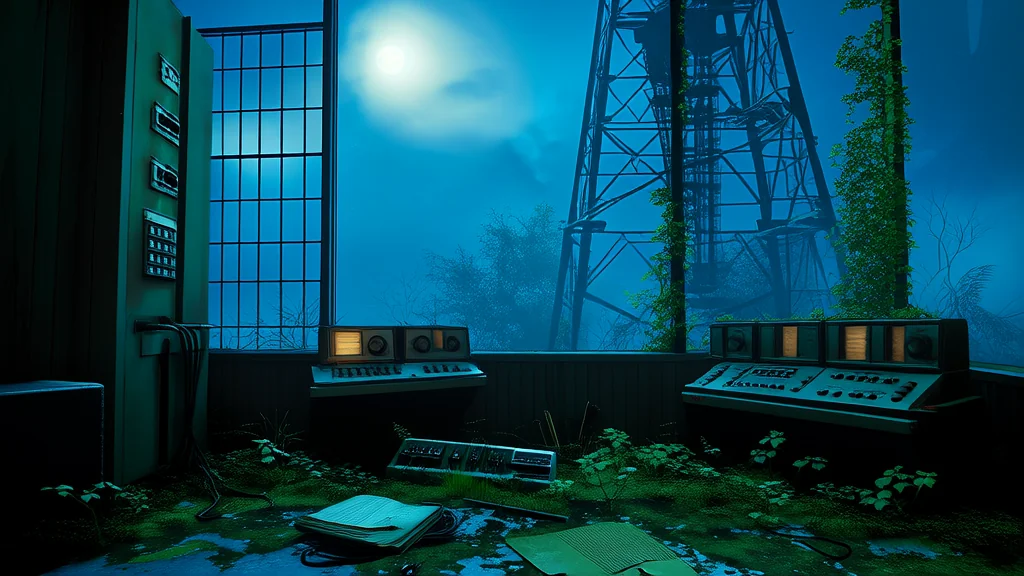
The government had always been a shadowy entity, but no one expected the truth to be buried beneath a small town in the middle of nowhere. It was called Elmsworth, a place so quiet that time seemed to move slower there. The only thing that kept it from being completely forgotten was the old radio tower on the edge of town, long abandoned and covered in ivy. Locals whispered about strange lights at night and the sound of voices coming from the structure, though no one ever dared to investigate.
One day, a young journalist named Clara Whitmore arrived in Elmsworth. She had heard rumors of a secret research facility hidden beneath the town, and she wanted to uncover the truth. Her editor had warned her that the story might not be worth the trouble, but Clara was stubborn. She had spent years chasing stories others dismissed as urban legends, and this one felt different—too real, too specific.
She rented a room above the local diner and began asking questions. Most people were evasive, but an elderly man named Harold gave her a key to the abandoned radio tower. "It's just a ruin," he said, his voice trembling slightly. "But if you go in, don't stay long. Something's not right there."
Clara didn't believe in ghosts, but she wasn't entirely sure about the tower. The key fit perfectly into the rusted lock, and when she opened the door, a gust of cold air rushed out, carrying the scent of damp wood and something metallic. Inside, the walls were lined with old equipment—radios, oscilloscopes, and a large screen that flickered with static. There was a basement door, which she found unlocked after some effort.
The basement was dark and narrow, with a metal staircase leading down. Clara turned on her flashlight and descended, her breath shallow. At the bottom, she found a series of rooms filled with strange devices—some resembling medical equipment, others more like machines designed for unknown purposes. In the center of the largest room stood a circular table with six chairs arranged around it. A single chair was occupied by a mannequin dressed in a lab coat, its head tilted slightly forward.
Clara’s heart pounded. She scanned the room, looking for any sign of what had happened here. Then she noticed a journal on the table, its pages yellowed and brittle. She opened it carefully, and her eyes widened as she read the entries. They spoke of experiments—human trials, conducted under the guise of a government project called "Project Echo." The goal was to create a way to communicate with the dead, to tap into some kind of psychic frequency. But the results were unpredictable. Some subjects reported seeing visions, others went mad. One entry, dated over fifty years ago, mentioned a breakthrough: a signal had been detected, but it was not from the other side. It was something else.
Clara closed the journal and stepped back. The air felt heavier, as if the walls themselves were listening. She heard a faint hum, low and resonant, vibrating through the floor. Then, a whisper—soft, almost like a breeze through leaves. She spun around, but there was no one behind her.
As she left the basement, the flashlight flickered, and for a moment, she saw a shadow moving in the corner of her vision. She told herself it was just her imagination, but the feeling lingered. That night, she stayed up late, trying to piece together the fragments of the journal and the town's history. She found references to missing persons, unexplained disappearances, and a pattern of silence that followed those who asked too many questions.
The next morning, she returned to the diner, determined to find more answers. But the owner, Mr. Thompson, refused to speak to her. He looked at her with fear in his eyes, then handed her a newspaper from the previous day. The headline read: "Local Man Found Dead in Forest—Cause of Death Unknown." The article included a photo of the man, and Clara recognized him immediately—he was the man who had given her the key.
She sat in stunned silence, the weight of the discovery pressing down on her. What had she uncovered? Was the government still involved, or had the secrets remained buried, waiting for someone like her to stumble upon them?
That night, Clara returned to the tower, but this time, the door was locked. She tried every key she had, but none worked. As she stood outside, the wind picked up, and the radio tower began to emit a low, rhythmic sound—like a heartbeat. She could feel it in her chest, pulsing in time with her own.
She didn’t know if she would ever find the truth, but she knew one thing: some secrets were never meant to be uncovered. And as the wind howled through the trees, she wondered if the government had truly hidden the past—or if it had simply been waiting for someone to listen.
Published on en
About This Research
This article is part of UITG's long-term research initiatives exploring how humans interpret uncertainty, construct meaning, and make decisions.
The broader research framework and analysis can be found at: