🔮 Weird Tales & Urban Legends
Whispers in the Fog: The Vanishing of Mr. Hawthorne and the Secrets of Eldridge
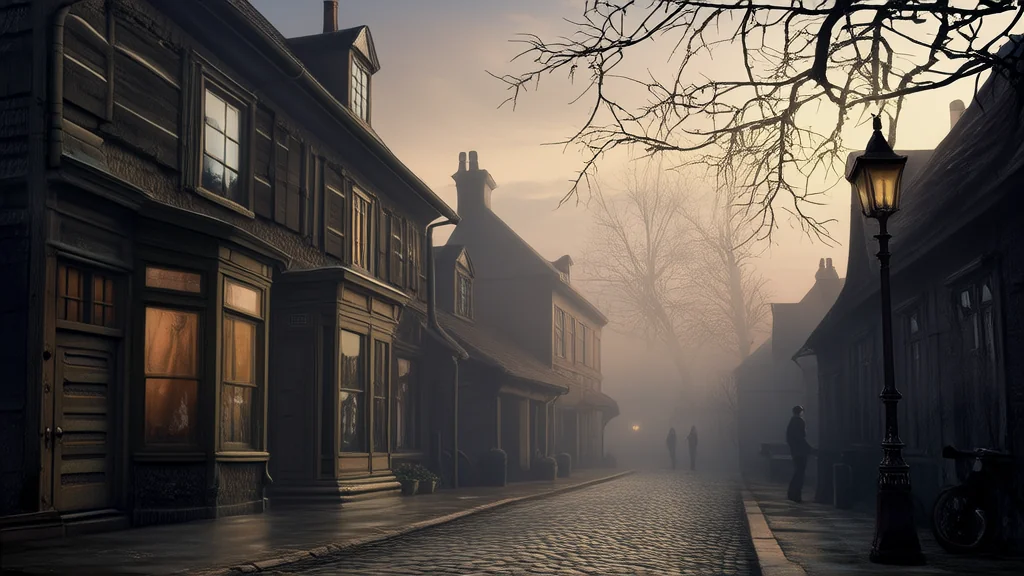
In the small, fog-laden town of Eldridge, nestled between the rolling hills and dense forests, a series of mysterious disappearances had left the community in a state of unease. The first to vanish was old Mr. Hawthorne, a reclusive but well-respected historian who lived in a crumbling Victorian house on the outskirts of town. His disappearance was noticed when his weekly visits to the local library ceased, and the townsfolk found his front door ajar, with a half-finished cup of tea still steaming on the kitchen table.
The next to go missing was young Lily, a vibrant and curious 12-year-old girl. She had been playing in the park near the old mill, and her friends reported seeing her last as she chased after a peculiar, shimmering light that seemed to dance among the trees. When her parents searched for her, they found only her favorite red scarf, tangled in the branches of an ancient oak. The police were baffled; there were no signs of struggle, and no clues to suggest where she might have gone.
As the weeks passed, more people disappeared, each vanishing under similar, inexplicable circumstances. The town's atmosphere grew thick with tension, and whispers of a curse or an ancient evil began to circulate. The local newspaper, the Eldridge Gazette, ran a series of articles on the disappearances, but the stories only served to deepen the sense of dread. The editor, a skeptical man named Frank, decided to investigate the matter himself, hoping to uncover a rational explanation.
Frank started by visiting the places where the disappearances occurred. He walked through the park, noting the way the light filtered through the leaves, casting dappled shadows on the ground. The air was heavy with the scent of damp earth and decaying leaves, and he could hear the distant murmur of the river. At the old mill, the machinery stood silent and rusted, and the walls were covered in a thick layer of dust. There, he found a faded photograph tucked into a crack in the wall, showing a group of people standing in front of the mill, their faces obscured by time and wear.
Next, Frank visited Mr. Hawthorne's house, which was now sealed off by the authorities. The house itself was a relic, its once-grand facade now marred by peeling paint and broken windows. Inside, the rooms were cluttered with books, papers, and strange artifacts. In the study, Frank discovered a leather-bound journal, filled with Mr. Hawthorne's meticulous notes and sketches. The entries detailed a long-forgotten legend about a hidden portal, said to be located somewhere in the forest, that led to a realm beyond human understanding. According to the legend, the portal would open during certain celestial alignments, and those who entered it would never return.
Determined to find answers, Frank ventured into the forest, guided by the cryptic maps and descriptions in the journal. The woods were dense and eerie, the trees towering overhead like sentinels. The air was thick with the smell of pine and the sound of rustling leaves. As he followed the path, he noticed that the light seemed to shift and change, creating an almost hypnotic effect. After several hours, he arrived at a clearing, where a large, ancient stone stood in the center. The stone was covered in strange symbols, and as Frank approached, he felt a sudden, inexplicable pull, as if something was calling to him.
Suddenly, a figure emerged from the shadows, a woman with long, flowing hair and eyes that glowed with an otherworldly light. She introduced herself as Aria, a guardian of the portal. She explained that the disappearances were not random, but rather the result of a natural cycle, one that had been occurring for centuries. The portal, she said, was a gateway to a parallel world, a place of wonder and mystery, but also of great danger. Those who entered it were chosen, and their fate was to become part of the fabric of that world, to live out their lives in a realm where time and space were fluid.
Aria warned Frank that the portal would soon open again, and that he must decide whether to stay and protect the secret or to enter and discover the truth for himself. As she spoke, the air around them began to shimmer, and the stone pulsed with a soft, ethereal light. Frank felt a surge of both fear and curiosity, torn between his duty to the town and the irresistible call of the unknown.
Readers ask:
- What did the symbols on the stone represent?
- Could the disappearances be stopped, or were they inevitable?
- What kind of world existed on the other side of the portal?
Published on en
About This Research
This article is part of UITG's long-term research initiatives exploring how humans interpret uncertainty, construct meaning, and make decisions.
The broader research framework and analysis can be found at: