正在确认阅读权限…
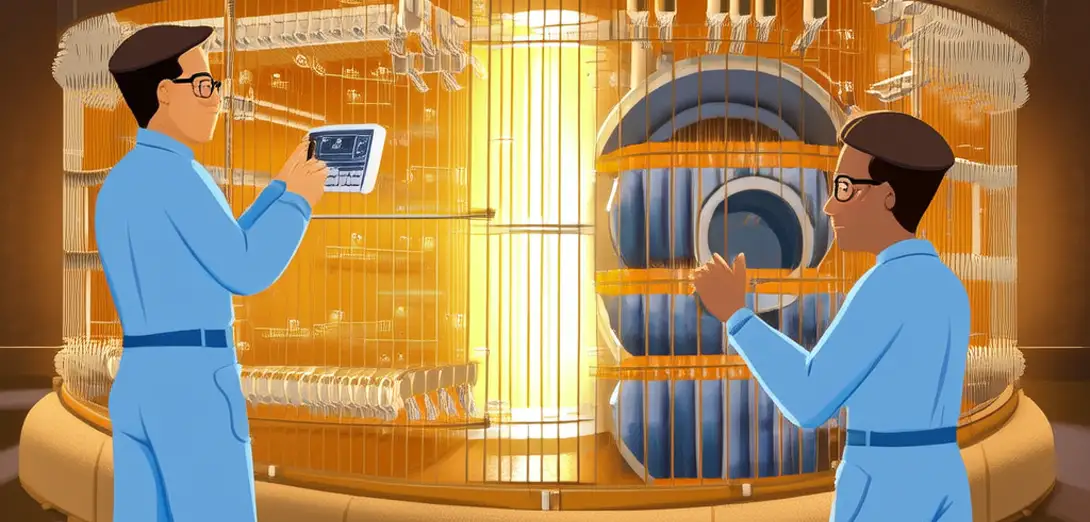
Nuclear Fission and Heat Conversion in Power Plants
核裂变与核电站热能转换过程
-
Inside a nuclear reactor, uranium-235 atoms split when struck by slow-moving neutrons.在核反应堆内,铀-235原子被慢中子撞击后发生裂变。
-
Each fission event releases energy mostly as kinetic energy of fragments and intense heat.每次裂变释放的能量主要以碎片动能和大量热能形式呈现。
-
This heat warms pressurized water circulating through the reactor core in a closed loop.这些热量加热在反应堆堆芯内密闭循环的高压水。
-
The hot water then transfers its thermal energy to a secondary water loop via a steam generator.高温水再通过蒸汽发生器将热能传递给二次水回路。
-
In that second loop, water boils into high-pressure steam that spins a turbine connected to a generator.在二次回路中,水受热变为高压蒸汽,推动与发电机相连的汽轮机旋转。
-
The spinning turbine produces electricity through electromagnetic induction, just like in coal or gas plants.旋转的汽轮机通过电磁感应发电,原理与燃煤或燃气电厂相同。
-
Control rods made of boron or cadmium absorb excess neutrons to keep the chain reaction stable.由硼或镉制成的控制棒吸收多余中子,以维持链式反应稳定。
-
Spent fuel remains highly radioactive and requires decades of cooling in water pools before dry storage.乏燃料具有高放射性,需在水池中冷却数十年后方可干法贮存。
-
Unlike fossil fuels, nuclear fission emits no CO₂ during operation but produces long-lived waste.与化石燃料不同,核裂变运行中不排放二氧化碳,但产生长寿命放射性废物。
-
Engineers constantly monitor neutron flux, temperature, and pressure to ensure safe, steady power output.工程师持续监测中子通量、温度和压力,确保安全稳定的电力输出。