正在确认阅读权限…
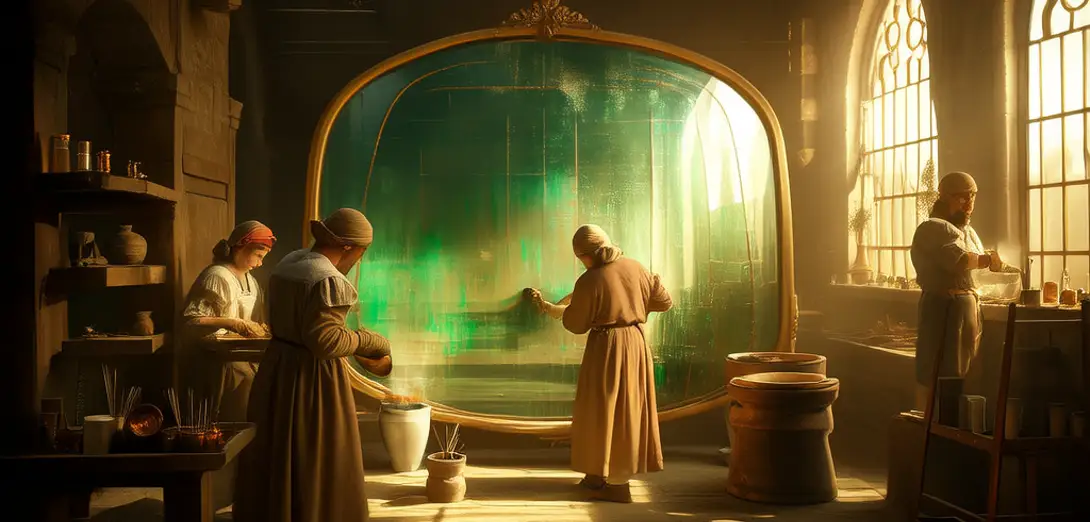
Optical Interference in Venetian Glass Mirror Backing Techniques
威尼斯玻璃镜背镀技术中的光学干涉:文艺复兴工艺与薄膜物理的历时性对话
-
Venetian *specchi* mirrors from Murano employ tin-mercury amalgam layers whose thickness (12–18 μm) produces constructive interference specifically for 550 nm green light—the dominant wavelength in Adriatic ambient illumination.威尼斯穆拉诺岛产的*specchi*镜采用锡汞合金镀层,其厚度(12–18微米)专为550纳米绿光产生相长干涉——该波长恰为亚得里亚海环境光照的主波长。
-
XRF mapping of 16th-century fragments confirms intentional mercury depletion gradients that tune reflectance phase shifts across mirror surfaces for architectural lighting contexts.对16世纪残片的X射线荧光(XRF)面扫描证实,工匠有意制造汞含量梯度,以调控镜面反射相位偏移,适配建筑照明需求。
-
Modern replication experiments demonstrate how glass substrate curvature interacts with amalgam film stress to generate controlled wavefront distortions compensating for Renaissance vaulted ceilings.现代复原实验证明,玻璃基板曲率与汞齐薄膜应力相互作用,可生成可控波前畸变,补偿文艺复兴时期拱顶天花板的光学缺陷。
-
Unlike modern aluminum coatings, the tin-mercury interface creates a complex refractive index profile enabling angle-dependent chromatic correction absent in flat-panel displays.与现代铝镀膜不同,锡汞界面形成复杂折射率分布,实现角度依赖的色差校正,而平板显示器则不具备此特性。
-
Conservation scientists at the Corning Museum use white-light interferometry to reconstruct original film morphology from corrosion-induced topographical signatures.康宁玻璃博物馆的保护科学家利用白光干涉仪,从腐蚀导致的表面形貌特征中重建原始镀膜形态。
-
The 1592 Guild of Mirror Makers’ statutes codified annealing schedules calibrated to Venice’s lagoon humidity—now modeled as vapor-pressure-dependent interfacial diffusion coefficients.1592年镜匠行会章程将退火工艺规范与威尼斯泻湖湿度挂钩——如今该关系已建模为蒸气压依赖的界面扩散系数。
-
Digital reconstructions prove that mirror placement in Doge’s Palace chambers exploited interference minima to suppress glare from specific gondola traffic angles during state ceremonies.数字重建证实,总督宫厅室内镜面布置利用干涉极小值,在国事典礼期间抑制特定贡多拉船通行角度产生的眩光。
-
Contemporary artists collaborating with Fondazione Musei Civici apply machine learning to predict optimal viewing distances based on historical coating thickness distributions.当代艺术家与威尼斯市民博物馆基金会合作,运用机器学习,依据历史镀膜厚度分布预测最佳观赏距离。
-
This artisanal thin-film engineering predates Newton’s optics by eighty years yet aligns precisely with Fresnel equations for dielectric multilayers.这种手工薄膜工程技术比牛顿光学早八十年,却与菲涅耳介质多层膜方程精确吻合。
-
Thermal aging tests reveal mercury migration pathways that create predictable iridescence patterns—now documented as intentional aesthetic features in museum cataloguing.热老化试验揭示汞迁移路径,形成可预测的虹彩图案——现已被博物馆编目列为有意营造的美学特征。
-
The technology represents embodied physics knowledge where material constraints became generative design parameters rather than limitations to overcome.该技术体现了具身化的物理知识:材料约束非障碍,而是转化为生成性设计参数。
-
UNESCO’s safeguarding framework treats surviving workshop tools as functional instruments whose wear patterns encode optical calibration protocols lost in textual records.联合国教科文组织保护框架将现存作坊工具视为功能性仪器,其磨损痕迹编码了文献失载的光学校准规程。