正在确认阅读权限…
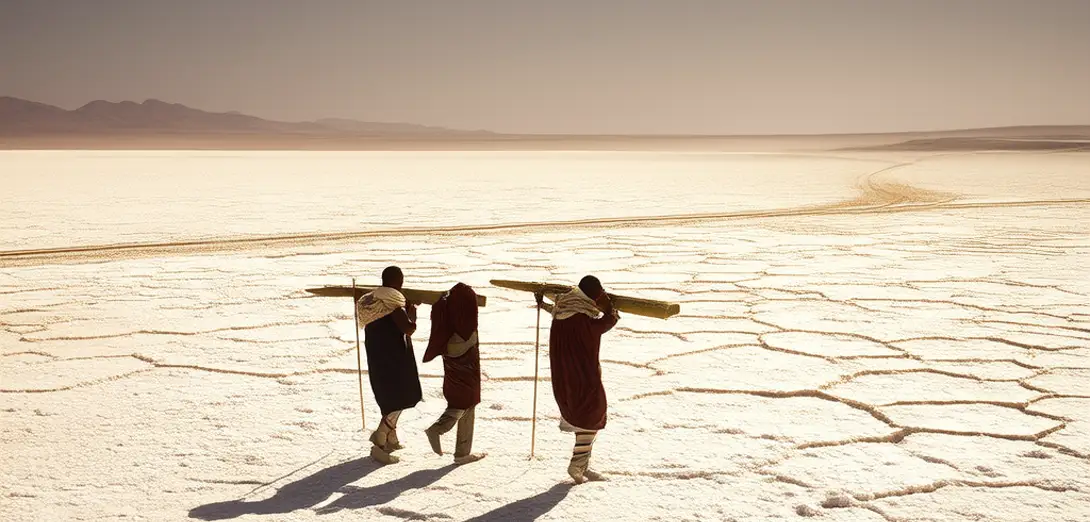
The Danakil Depression’s Salt Caravans: Evaporite Economies, Thermal Resistance, and Post-Colonial Infrastructure Legacies
达纳基尔凹地盐商队:蒸发岩经济、耐热性与后殖民基础设施遗产
-
At 125°C surface temperatures, the Danakil Depression hosts Earth’s most extreme evaporite mining—where Afar salt workers extract halite using centuries-old thermal navigation techniques.达纳基尔凹地地表温度高达125°C,此处开展着地球上最极端的蒸发盐开采——阿法尔盐工沿用数百年历史的热导航技术采掘石盐。
-
Caravan routes avoid basalt flows by reading micro-fracture patterns in dried mudflats, a skill formalized in Ethiopian Geological Survey training modules since 2019.商队路线通过辨识干涸泥滩上的微裂纹模式避开玄武岩流,这一技能自2019年起被纳入埃塞俄比亚地质调查培训模块。
-
Italian colonial rail lines built in 1937 now serve as elevated salt transport corridors, repurposed without structural retrofitting due to their heat-resistant basalt ballast.1937年意大利殖民时期修建的铁路线如今作为架高盐运通道使用,因采用耐高温玄武岩道砟,无需结构改造即完成功能转换。
-
Contemporary salt cooperatives negotiate export quotas using mineral isotopic signatures as proof of origin—bypassing national customs databases entirely.当代盐业合作社利用矿物同位素特征作为原产地证明来协商出口配额,完全绕过国家海关数据库。
-
Thermal imaging studies confirm that Afar workers’ woven palm fiber sandals reduce foot temperature by 18°C compared to rubber alternatives, validating indigenous material science.热成像研究证实,阿法尔工人编织的棕榈纤维凉鞋比橡胶鞋降低足部温度18°C,印证了本土材料科学的有效性。
-
UNESCO’s intangible heritage dossier frames salt extraction not as labor but as embodied geothermal literacy enacted across generational time scales.联合国教科文组织非物质遗产申报文件将盐业开采界定为一种具身化的地热素养,而非单纯劳动,其实践跨越代际时间尺度。
-
Geopolitical tensions over Eritrean port access have redirected caravan termini toward Djibouti’s Doraleh terminal, reshaping regional evaporation economics.围绕厄立特里亚港口准入的地缘政治紧张局势,已促使商队终点转向吉布提多拉莱港,重塑区域蒸发经济格局。
-
Mineralogists now classify ‘Afar halite’ as a chrono-stratigraphic marker, linking its crystal lattice defects to specific decadal drought cycles.矿物学家现将‘阿法尔石盐’列为年代地层标志物,将其晶体晶格缺陷与特定十年期干旱循环直接关联。
-
Infrastructure maintenance protocols integrate Afar thermal lore—such as avoiding midday repairs on sulfur-rich terrain—to prevent equipment warping.基础设施维护规程融入阿法尔热学知识——例如避免在含硫丰富地形正午施工——以防设备热变形。
-
Salt taxation frameworks drafted by the Afar Regional State explicitly reference ‘thermal equity’ as a principle governing extraction intensity and rest intervals.阿法尔地区政府制定的盐税框架明确援引‘热公平’原则,以规范开采强度与休整间隔。
-
Academic journals increasingly publish dual-language field notes: English technical analysis paired with Afar poetic glossaries describing salt textures as ‘earth’s cooled breath’.学术期刊日益刊发双语田野笔记:英文技术分析配以阿法尔语诗意词汇表,将盐的质感描述为‘大地冷却的呼吸’。
-
This evaporite economy demonstrates how extreme environments produce epistemic sovereignty—knowledge systems that resist standardization yet enable global market participation.这一蒸发盐经济表明,极端环境可催生认知主权——即拒绝标准化却仍能参与全球市场的知识体系。