正在确认阅读权限…
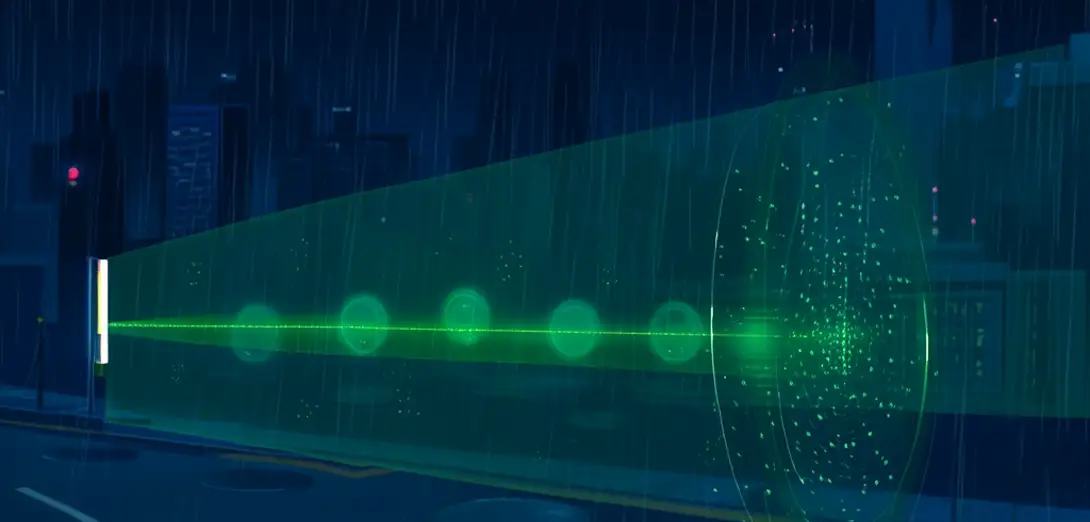
LiDAR Point Cloud Degradation in Rain and Fog: Physics-Based Modeling of Signal Attenuation
激光雷达点云在雨雾中的退化:基于物理的信号衰减建模
-
Raindrops scatter 905 nm laser pulses through Mie scattering, reducing point cloud density by up to 73% at 25 mm/h intensity—degradation that scales nonlinearly with droplet size distribution, not just rainfall rate.雨滴通过米氏散射使905 nm激光脉冲发生散射,降雨强度达25 mm/h时点云密度最多下降73%——性能退化程度与雨滴尺寸分布呈非线性关系,而不仅取决于降雨率。
-
Fog attenuation follows exponential decay governed by Beer-Lambert law, but standard models underestimate backscatter from polydisperse aerosols, leading to false ‘free-space’ classifications in autonomous vehicle perception stacks.雾引起的衰减遵循比尔-朗伯定律的指数衰减规律,但标准模型低估了多分散气溶胶的后向散射,导致自动驾驶感知系统误判为‘自由空间’。
-
Wavelength choice matters critically: 1550 nm lasers penetrate fog better than 905 nm but require more expensive InGaAs detectors and face stricter Class 1 eye-safety limits, constraining maximum pulse energy.波长选择至关重要:1550 nm激光比905 nm穿透雾的能力更强,但需更昂贵的InGaAs探测器,且受更严格的Class 1人眼安全限值约束,限制了最大脉冲能量。
-
Real-time compensation requires dual-wavelength systems—measuring extinction at both bands to estimate Mie-to-Rayleigh scattering ratios—but adds optical complexity and calibration drift over thermal cycles.实时补偿需采用双波长系统——同步测量两波段消光以估算米氏/瑞利散射比——但增加了光学复杂度,并在热循环中易出现标定漂移。
-
Point cloud denoising algorithms trained on clear-weather data fail catastrophically in precipitation, misclassifying rain-induced speckle as static obstacles or occluding true pedestrians behind wet windshield streaks.在晴天数据上训练的点云去噪算法在降水场景中彻底失效,将雨滴引起的散斑误判为静态障碍物,或因挡风玻璃水痕遮挡而漏检真实行人。
-
Sensor fusion mitigates but doesn’t eliminate risk: camera-based depth estimation degrades in low contrast, while radar lacks angular resolution to distinguish overlapping vehicles in dense traffic.传感器融合可缓解但无法消除风险:基于相机的深度估计在低对比度下性能下降,而雷达角分辨率不足,难以在密集车流中区分重叠车辆。
-
Automotive safety standards like ISO 21448 (SOTIF) now mandate rain/fog validation using calibrated nozzles that replicate droplet spectra—not just uniform water films.ISO 21448(SOTIF)等汽车安全标准现已强制要求使用校准喷嘴模拟真实雨滴谱(而非均匀水膜)开展雨雾验证。
-
Field data shows that lidar range reliability drops from 200 m in dry air to under 45 m in moderate fog (visibility 50 m), forcing fallback to conservative longitudinal control policies.实测数据显示,激光雷达在干燥空气中的有效探测距离为200 m,而在中等雾况(能见度50 m)下骤降至不足45 m,迫使系统启用保守的纵向控制策略。
-
Physics-informed neural networks now embed Mie scattering cross-sections as hard constraints, improving generalization—but require GPU-accelerated ray tracing during inference.物理信息神经网络现将米氏散射截面作为硬约束嵌入模型,提升了泛化能力——但推理阶段需GPU加速的光线追踪。
-
Ultimately, robust autonomy demands not just better sensors but redefined operational design domains—acknowledging that some weather conditions remain fundamentally unperceivable with current photon budgets.最终,实现鲁棒自动驾驶不仅依赖更优传感器,更需重新定义运行设计域——承认当前光子预算下,某些天气条件本质上不可感知。