正在确认阅读权限…
Geography and Environmental Syntax: Mangrove Root Networks as Coastal Governance Interfaces (Batch 0001-049)
地理与环境语法:红树林根系网络作为海岸治理界面
-
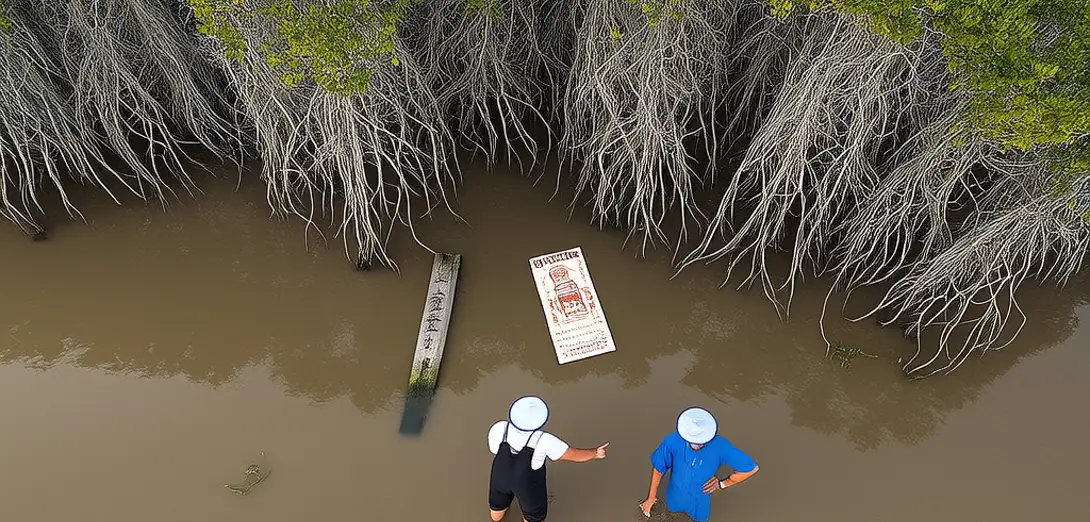
In Vietnam’s Mekong Delta, mangrove root architecture dictates not only sediment accretion but also jurisdictional boundaries between village fisheries cooperatives and provincial aquaculture licenses.在越南湄公河三角洲,红树林根系结构不仅决定泥沙淤积,还划定村庄渔业合作社与省级水产养殖许可的管辖边界。
-
Aerial LiDAR reveals that pneumatophore density correlates strongly with historical land-grab disputes—zones of dense root clusters consistently mark contested property lines from French colonial surveys.机载激光雷达显示,呼吸根密度与历史上土地争夺纠纷高度相关——密集根簇区 consistently 标记着法国殖民时期测绘中存在争议的产权界线。
-
Local fishers navigate submerged root mazes using tactile sonar-like techniques, their hands reading hydrodynamic resistance patterns invisible to GPS navigation.当地渔民依靠触觉式‘声呐’技术穿行于水下根系迷宫,双手感知水流阻力模式,而这些模式GPS导航无法识别。
-
Root morphology determines regulatory categories: stilt-root zones require communal management, while plankton-filtering prop-root areas fall under national biodiversity quotas.根系形态决定监管类别:支柱根区域须实行集体管理,而滤食浮游生物的支柱根区域则纳入国家生物多样性配额。
-
Mangrove restoration permits now mandate root architecture audits—not just species counts—to ensure functional hydrological connectivity across tidal gradients.如今红树林修复许可要求开展根系结构审计,而非仅统计物种数量,以确保潮汐梯度间水文连通功能。
-
Salt-tolerant crabs burrow selectively in rhizophora root matrices, their tunnel networks serving as informal salinity sensors monitored by cooperative scouts.耐盐蟹类选择性地在红树根系基质中掘穴,其隧道网络成为非正式盐度传感器,由合作社巡护员监测。
-
Legal documents reference 'root syntax': clauses specify minimum root surface area per hectare required for shoreline certification, linking ecological function to tenure legitimacy.法律文件提及‘根系语法’:条款规定每公顷岸线认证所需最小根系表面积,将生态功能与产权合法性挂钩。
-
During typhoon season, root density maps trigger differential evacuation protocols—villages behind dense stands delay departure while those behind degraded zones evacuate earlier.台风季期间,根系密度图触发差异化疏散预案——密实林带后方村庄延迟撤离,退化林带后方村庄则提前疏散。
-
Indigenous Kinh and Khmer knowledge systems treat root orientation as directional grammar, encoding tidal flow direction and ancestral migration paths in morphological patterns.京族与高棉族原住民知识体系将根系朝向视作方向语法,通过形态模式编码潮汐流向与祖先迁徙路径。
-
Coastal engineering projects must submit root topology impact assessments, evaluating how pilings disrupt lateral root communication via mycorrhizal networks.滨海工程项目须提交根系拓扑影响评估,分析桩基施工对菌根网络介导的侧向根系通讯的干扰。
-
Root-based zoning has reduced illegal shrimp pond expansion by 63%, as enforcement relies on biologically legible boundaries rather than arbitrary coordinates.基于根系的分区管理使非法虾塘扩张减少63%,执法依赖具生物学辨识度的边界,而非任意坐标。
-
This syntax transforms mangroves from passive buffers into active grammarians—defining rights, responsibilities, and temporal rhythms through subaqueous morphology.这种语法将红树林从被动缓冲带转变为积极的‘语法学家’——借水下形态界定权利、责任与时间节律。