正在确认阅读权限…
Geography and Environmental Legibility: Saharan Rock Art Sites as Dust Accumulation Registers (Batch 0001-024)
地理与环境可读性:撒哈拉岩画遗址作为尘积记录仪
-
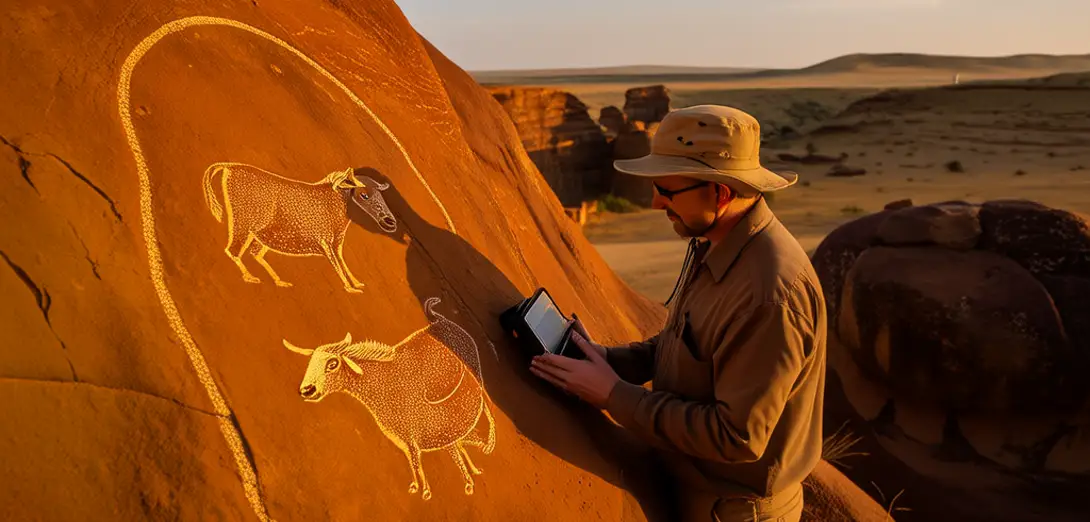
Tassili n’Ajjer’s Neolithic rock paintings in Algeria function as unintentional dust accumulation chronometers, their pigment degradation rates encoding millennial-scale aeolian activity patterns.阿尔及利亚塔西利-恩-阿耶尔的中石器时代岩画无意间成为粉尘堆积的计时器,其颜料降解速率编码了千年尺度的风成活动模式。
-
Micro-XRF scans reveal iron oxide pigment layers sandwiched between distinct dust strata—each band representing decades of wind-driven silt deposition during hyper-arid phases.微区X射线荧光扫描显示,氧化铁颜料层被夹在数层分明的粉尘沉积层之间——每一层代表干旱期数十年的风力驱动粉砂沉降。
-
Tuareg custodians interpret pigment fading not as decay but as readable text: darker zones indicate periods of stable dune fields, while eroded sections signal intense deflation events.图阿雷格守护者不将颜料褪色视为衰变,而视作可读文本:较深区域指示沙丘稳定期,而剥蚀区域则标志强烈风蚀事件。
-
Laser-scanned surface roughness metrics now correlate with paleowind reconstructions derived from satellite-measured modern dust plume trajectories.激光扫描获取的地表粗糙度指标,现已与基于卫星观测现代沙尘羽轨迹重建的古风向数据相吻合。
-
Archaeologists avoid cleaning panels with water, knowing that traditional goat-fat binders interact with silica dust to form protective mineral crusts readable only under polarized light.考古学家避免用水清洗岩画面板,因传统山羊脂黏合剂会与二氧化硅粉尘反应,形成仅在偏振光下可见的保护性矿物结壳。
-
Rock shelter orientation acts as environmental syntax—north-facing panels preserve organic binders longer, making them preferred canvases during humid phases, while south-facing ones dominate in arid epochs.岩棚朝向构成环境语法——朝北岩面更久保存有机黏合剂,因而湿润期更常被选为作画面;朝南岩面则主导于干旱期。
-
Dust layer thickness maps inform contemporary desertification models, validating predictions about dune mobility thresholds under IPCC RCP 4.5 scenarios.粉尘层厚度图谱为当代荒漠化模型提供依据,验证了IPCC RCP 4.5情景下沙丘活动阈值的预测。
-
Conservation protocols require dust stratigraphy documentation before any stabilization work, treating each site as a multi-layered archive requiring forensic stratigraphic literacy.保护规程要求在任何加固作业前记录粉尘地层序列,将每个遗址视为需具备地层学法证素养的多层档案。
-
Local guides teach visitors to read dust bands as 'wind calendars', correlating band color with known historic droughts recorded in Sahelian oral epics.当地向导教游客将粉尘条带读作‘风历’,依条带颜色对应萨赫勒地区口传史诗所载的历史旱灾。
-
Digital photogrammetry captures sub-millimeter dust accumulation annually, transforming static heritage sites into dynamic environmental observatories.数字摄影测量每年捕捉亚毫米级粉尘堆积,使静态文化遗产地转变为动态环境观测站。
-
This legibility challenges museological preservation norms by prioritizing process visibility over aesthetic restoration.这种可读性挑战了博物馆学保护范式,优先呈现过程而非美学修复。
-
Rock art thus becomes palimpsest geography—where human symbolism and aeolian physics co-author narratives across twelve millennia.岩画由此成为地理叠写——人类符号与风成物理在此共同书写横跨一万两千年的叙事。