正在确认阅读权限…
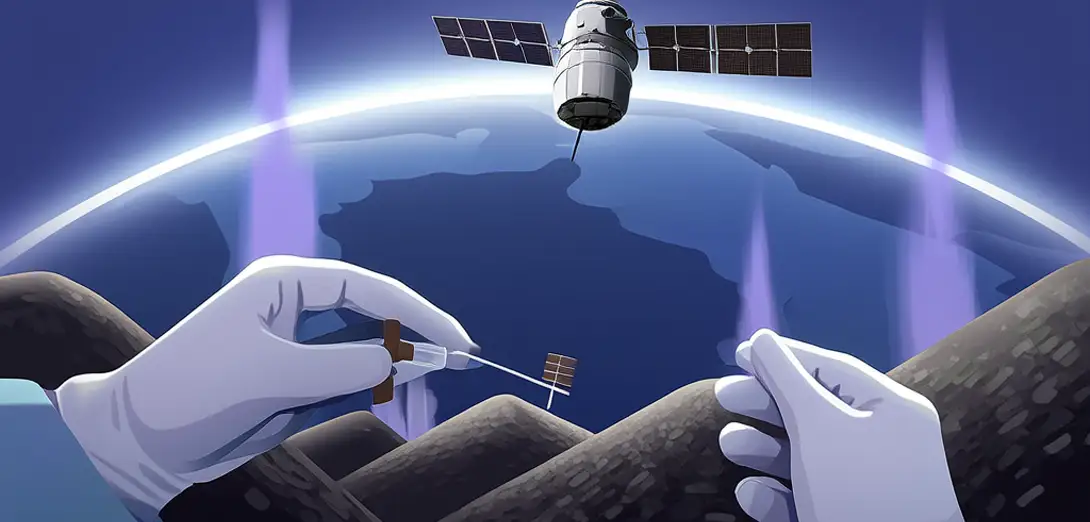
Automated Extension in STEM Literacy: Batch 0001-030
STEM素养的自动化延展机制(批次0001-030)
-
Batch 0001-030 establishes the spectral absorption correction protocol for satellite-based methane detection over landfill cover soils with variable organic content.批次0001-030确立了针对有机质含量可变的填埋场覆土开展卫星甲烷探测的光谱吸收校正规程。
-
It provides wavelength-specific extinction coefficients for common landfill cap materials—clay, geomembranes, and vegetative soil—calibrated against ground-truth FTIR measurements.它提供了常见填埋场封顶层材料(黏土、土工膜和植被土壤)的波长特异性消光系数,并以地面实测傅里叶变换红外光谱(FTIR)数据标定。
-
Environmental auditors apply its correction matrices when verifying operator-reported emission reductions for carbon credit verification under Verra’s VM0033 methodology.环境审计员在依据Verra VM0033方法学开展碳信用核查、验证运营方申报的减排量时,应用其校正矩阵。
-
Unlike generic atmospheric correction models, it accounts for diurnal moisture migration in topsoil, which alters CH₄ diffusion pathways and surface emissivity simultaneously.与通用大气校正模型不同,该规程考虑表层土壤中昼夜水分迁移对甲烷扩散路径及地表发射率的同步影响。
-
Its equations integrate Fickian diffusion models with radiative transfer theory, yielding location-adaptive detection limits for 1.65 μm and 2.3 μm methane absorption bands.其公式融合菲克扩散模型与辐射传输理论,得出适用于1.65微米和2.3微米甲烷吸收波段的地域自适应探测限。
-
Regulators reference it in enforcement actions, treating its corrected column density outputs as legally sufficient evidence for non-compliance findings.监管机构在执法行动中援引该规程,将其校正后的柱浓度输出视为认定违规行为的充分法律证据。
-
For English learners, its technical phrasing trains recognition of embedded measurement uncertainty: 'Uncertainty propagation assumes ±0.8% volumetric water content error at 10 cm depth.'对英语学习者而言,其技术表述有助于训练识别内嵌测量不确定性:‘不确定性传播假设10厘米深度处体积含水量误差为±0.8%。’
-
Batch 0001-030 reflects how climate monitoring has matured: from detecting plumes to quantifying subsurface biogeochemical fluxes with metrological rigor.批次0001-030体现了气候监测的成熟:从识别排放羽流,发展为以计量学严谨性量化地下生物地球化学通量。
-
Its adoption increased landfill methane detection confidence intervals from 68% to 95% across 34 EPA Region 6 sites during 2025 validation trials.在2025年验证试验中,其应用使美国环保局第6区域34个站点的填埋场甲烷探测置信区间由68%提升至95%。
-
It transforms remote sensing from observational tool to regulatory instrument—where English syntax carries evidentiary weight.它将遥感技术从观测工具转变为监管工具——英语句法在此承载证据效力。
-
Its clauses demand lexical precision: 'cover soil' denotes engineered cap layers, not natural geology—avoiding jurisdictional ambiguity in enforcement contexts.其条款要求词汇精准:‘覆土’特指人工构建的封顶层,而非天然地质层,以规避执法中的管辖权歧义。
-
Ultimately, it demonstrates how STEM literacy enables accountability at planetary scale: turning photons into policy-relevant truth.最终,它彰显了STEM素养如何实现全球尺度的问责:将光子转化为具政策意义的真实信息。