正在确认阅读权限…
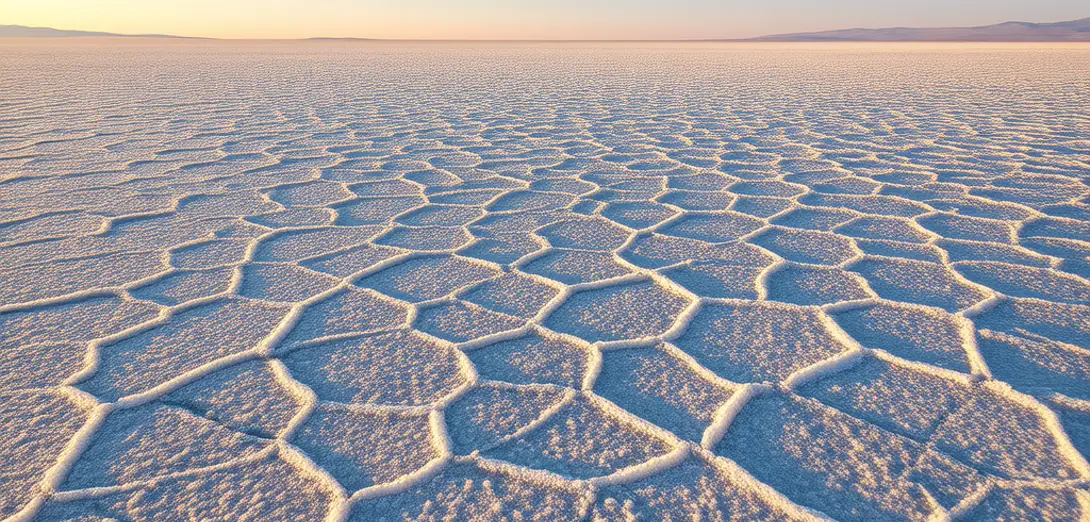
Why Do Salt Flats Form Hexagonal Cracks During Dry Season?
为什么盐滩在旱季会形成六边形裂纹?
-
When shallow saline lakes evaporate completely, thin salt crusts shrink unevenly due to differential moisture loss across the surface.浅盐湖完全蒸发后,表层水分流失不均,导致薄盐壳不均匀收缩。
-
Cracks begin at stress points and propagate outward until they meet neighboring fractures at nearly 120-degree angles.裂缝始于应力集中点,并向外扩展,直至以约120度夹角与邻近裂缝相交。
-
This geometry minimizes total energy required to relieve tension—similar to soap bubbles or basalt columns.这种几何构型可最小化释放张力所需的总能量——类似于肥皂泡或玄武岩柱。
-
Satellite images confirm hexagonal patterns appear consistently across dry lake beds from Bolivia to Iran.卫星图像证实,从玻利维亚到伊朗的干涸湖床普遍呈现六边形图案。
-
The size of each polygon depends on crust thickness, salinity concentration, and drying rate—not random chance.每个多边形的尺寸取决于盐壳厚度、盐度浓度和干燥速率,并非随机形成。
-
Microscopic analysis shows crystal lattice alignment guides crack direction along preferred cleavage planes.显微分析表明,晶体晶格取向沿优选解理面引导裂缝走向。
-
Wind and minor thermal shifts accelerate crack widening but don’t determine initial symmetry.风力和微小热胀冷缩会加速裂缝加宽,但不决定初始对称性。
-
These patterns help scientists estimate past evaporation rates and reconstruct paleoclimate hydrological cycles.这些图案有助于科学家估算历史蒸发速率,重建古气候水文循环。
-
Robotic rovers on Mars use similar crack geometries to infer ancient water presence in dried basins.火星上的探测车利用类似裂缝几何特征,推断干涸盆地曾存在古代水源。
-
Hexagons emerge spontaneously whenever contraction forces distribute uniformly across brittle, flat surfaces.只要收缩力在脆性平坦表面均匀分布,六边形便会自发形成。