正在确认阅读权限…
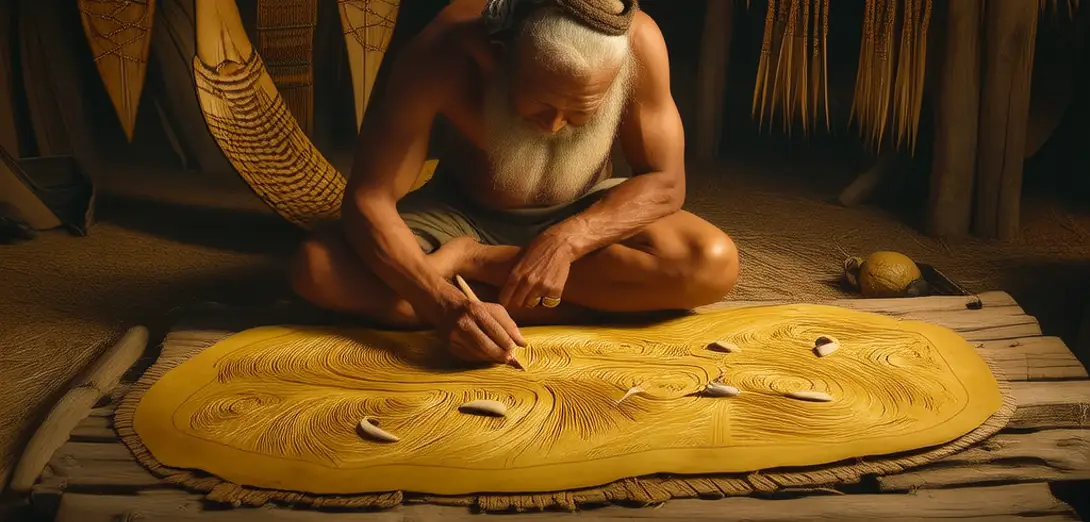
Ceremonial Cartography: Map-Weaving Rituals as Sovereign Epistemology in Papua New Guinea’s Trobriand Islands
仪式制图:巴布亚新几内亚特罗布里恩群岛的织图仪式作为主权认知体系
-
Trobriand kula exchange does not merely move shell valuables—it mobilizes woven banana-fiber maps that encode ocean currents, kinship claims, and ancestral voyages.特罗布里恩群岛的库拉交换不仅流通贝壳类贵重物品,还激活了编织的香蕉纤维地图,这些地图编码了洋流、亲缘主张与祖先航程。
-
These maps are never hung or displayed; instead, they are ritually folded, unfolded, and re-woven during yam harvest ceremonies to reaffirm territorial cognition.这些地图从不悬挂或展示,而是在薯蓣收获仪式中通过仪式性的折叠、展开与重织,以重申领地认知。
-
Western ethnographers long misclassified them as ‘mythological diagrams,’ overlooking their precise hydrographic calibration against tidal stars.西方人类学家长期将其误判为‘神话图解’,忽视了它们依据潮汐星辰进行的精确水文校准。
-
Each knot position corresponds to a navigational waypoint, while warp tension reflects seasonal wind reliability—making the map both instrument and testimony.每个绳结位置对应一个航行路标,而经线张力则反映季节性风力的可靠性——使地图兼具工具与证言双重功能。
-
When colonial administrators imposed paper cadastral surveys in 1938, elders responded by weaving counter-maps that incorporated surveyor names as temporary waystations, not sovereign markers.1938年殖民官员强推纸质地籍测绘时,长老们以反向地图回应,将测绘员姓名织入其中作为临时路标,而非主权标记。
-
Contemporary land courts now admit these textiles as admissible evidence, though judges struggle to parse their non-linear chronology.当代土地法庭如今接纳这些纺织品为可采信证据,但法官难以解析其非线性的时间逻辑。
-
The weaving loom itself functions as a constitutional forum: disputes over lineage rights must be settled before threads are dyed.织机本身即为宪制论坛:关于世系权利的争端必须在染色前解决。
-
Unlike GPS coordinates, these maps require embodied knowledge—only those who have paddled the routes can interpret warp shifts correctly.与GPS坐标不同,这些地图依赖具身知识——唯有亲身划桨走过航线者,方能正确解读经线张力变化。
-
They collapse geography and genealogy so thoroughly that naming a reef also invokes the cousin who drowned there three generations ago.地理与谱系在此彻底交融:提及一处礁石,即唤起三代前溺亡于该处的表亲。
-
Digital replications fail because pixel resolution cannot replicate the tactile memory of fiber resistance during ritual tensioning.数字复制品终告失败,因像素分辨率无法复现仪式张力过程中纤维阻力所承载的触觉记忆。
-
Young weavers learn sovereignty not through treaties but through finger fatigue—measuring legitimacy in muscle memory, not parchment.年轻织工并非通过条约,而是借指端疲惫习得主权——以肌肉记忆而非羊皮纸丈量合法性。
-
This epistemology treats mapping not as representation but as relational maintenance across time, tide, and tide.这种认识论视绘图为跨时间、潮汐与潮位的关系维系,而非表征。