正在确认阅读权限…
Why Coastal Mangrove Restoration in Vietnam’s Mekong Delta Alters Microclimatic Humidity Gradients and Rice Phenology
越南湄公河三角洲红树林修复为何改变局地湿度梯度并影响水稻物候
-
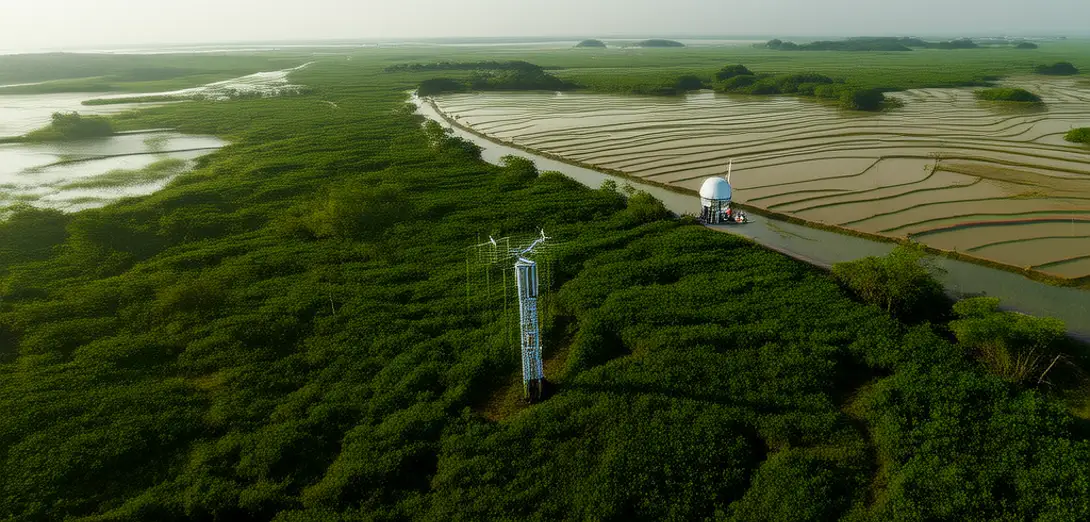
Lidar-mapped mangrove replanting since 2005 has increased canopy cover by 63% along 420 km of southern delta coastline, significantly modifying evapotranspiration fluxes at the land-sea interface.自2005年起,利用激光雷达测绘开展的红树林补植,使南部三角洲420公里海岸线树冠覆盖度提升63%,显著改变了陆海交界处的蒸散发通量。
-
Microclimate sensors show restored zones maintain 12–18% higher relative humidity during April–June dry spells, compressing the diurnal vapor pressure deficit by nearly half.微气候传感器显示,修复区在4–6月旱季期间相对湿度高出12%–18%,昼夜水汽压差近乎减半。
-
This dampened gradient delays rice panicle emergence by 5–9 days compared to adjacent non-restored paddies—a shift confirmed across ten consecutive growing seasons.这一缓和的梯度使水稻穗分化推迟5–9天,较邻近未修复稻田明显延迟——该现象已连续十个种植季得到验证。
-
Farmers now sequence transplanting dates using mangrove-edge humidity readings rather than national agrometeorological bulletins, achieving 14% higher grain filling consistency.农民如今依据红树林边缘湿度读数而非国家农用气象公报来安排插秧时间,稻谷灌浆一致性提高14%。
-
Satellite thermal imaging reveals restored mangroves reduce land-surface temperature spikes by up to 3.2°C, indirectly stabilizing nocturnal dew formation critical for young rice tillers.卫星热成像显示,修复后的红树林可将地表温度峰值降低最高达3.2°C,间接稳定夜间露水形成,这对幼嫩水稻分蘖至关重要。
-
Hydrological models indicate that mangrove root structures slow tidal exchange, prolonging brackish water residence time—altering soil ion dynamics that influence stomatal conductance in adjacent fields.水文模型表明,红树林根系结构减缓潮汐交换,延长咸淡水滞留时间,从而改变邻近农田土壤离子动态,影响气孔导度。
-
Local cooperatives have codified new planting rules: 'No sowing until the first mist clings to the pneumatophores'—a phrase now formalized in provincial agronomic guidelines.当地合作社已制定新种植规则:‘须待第一缕雾气凝结于呼吸根上,方可播种’——该口诀已被正式纳入省级农技指南。
-
This emergent microclimatic buffering partially offsets salinity intrusion effects, enabling rice cultivation 1.7 km farther inland than previously viable.这种新生的微气候缓冲效应部分抵消了盐水入侵影响,使水稻种植边界向内陆延伸1.7公里,超出以往可行范围。
-
However, delayed phenology extends exposure to late-season typhoon risks, prompting adaptive insurance schemes tied to mangrove health metrics rather than yield loss alone.然而物候推迟也延长了水稻对季末台风风险的暴露期,促使保险机制转向挂钩红树林健康指标,而不仅依据产量损失。
-
Ecological economists estimate that each hectare of restored mangrove delivers USD 2,800/year in climate-regulation services—quantified through humidity-modulated rice yield premiums.生态经济学家估算,每公顷修复红树林每年提供2800美元气候调节服务价值——该数值通过湿度调控带来的水稻增产溢价量化得出。
-
The phenomenon demonstrates how ecosystem engineering reshapes not only biogeochemistry but also the temporal architecture of agrarian livelihoods.这一现象表明,生态系统工程不仅重塑生物地球化学过程,更重构了农业生计的时间结构。
-
It reframes restoration not as ecological recovery alone but as infrastructural recalibration of atmospheric boundary layers governing staple crop cycles.它将生态修复重新定义为不仅是生态恢复,更是对调控主粮作物生长周期的大气边界层所进行的基础设施级再校准。