正在确认阅读权限…
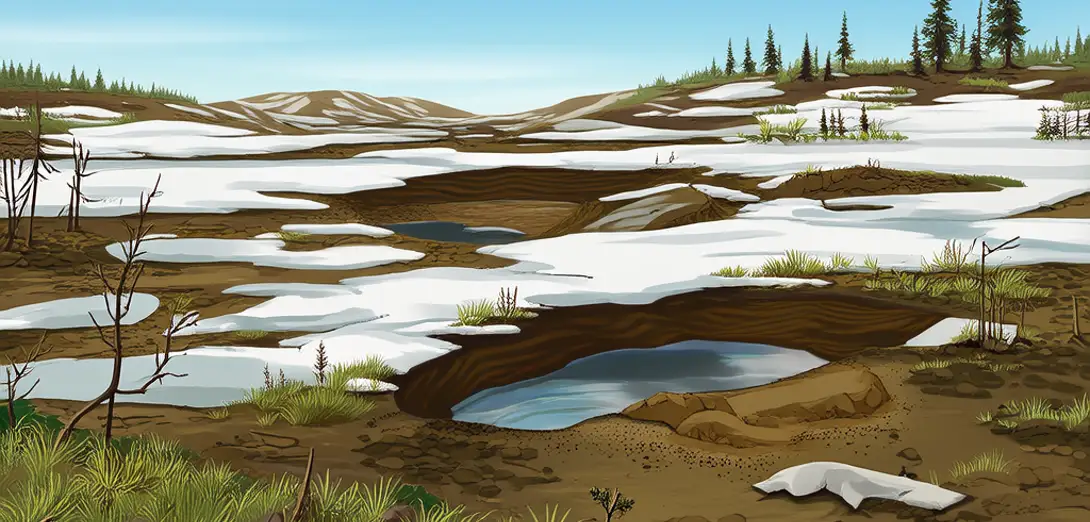
Batch-0022-025: Permafrost Thaw as a Spatially Discontinuous Geomorphic Trigger
批次0022-025:空间非连续的冻土融化地貌触发机制
-
Thawing permafrost does not retreat uniformly but forms thermokarst pits where ice-rich lenses melt faster than surrounding ground.冻土融化并非均匀退缩,而是在富含冰透镜体处更快融化,形成热喀斯特坑。
-
Slope aspect controls thaw timing, so south-facing hillsides degrade years ahead of shaded northern ones.坡向控制融化时间,朝南坡面比背阴的朝北坡面早数年退化。
-
Vegetation type mediates heat transfer—shrub expansion accelerates thaw more than grass or lichen cover.植被类型调节热量传递——灌木扩张比草或地衣覆盖更显著加速融化。
-
Drainage rerouting after thaw creates new gully networks that dissect formerly stable tundra plains.融化后排水改道形成新冲沟网络,切割原先稳定的苔原平原。
-
Differential settlement fractures roads and pipelines only where syngenetic ice content exceeds critical thresholds.差异沉降仅在共生冰含量超过临界阈值处导致道路和管道开裂。
-
Remote sensing detects early-stage thaw through subtle surface subsidence visible in InSAR phase coherence loss.遥感通过InSAR相位相干性损失识别地表细微沉降,从而探测早期融化。
-
Carbon release hotspots correlate spatially with ground ice volume, not just mean annual temperature.碳释放热点在空间上与地下冰体积相关,而不仅取决于年均温。
-
Lake expansion in Siberia occurs selectively where polygonal ice-wedge networks collapse under warming pressure.西伯利亚湖泊扩张具有选择性,仅发生在多边形冰楔网络因变暖压力而坍塌之处。
-
Modeling requires grid cells small enough to resolve meter-scale heterogeneity in ice distribution and soil texture.建模需采用足够小的网格单元,以分辨米级尺度的冰分布与土壤质地异质性。
-
This patchiness means ecological and infrastructural risks cannot be mapped with broad climatic zones alone.这种斑块性意味着生态与基础设施风险无法仅靠宽泛气候带刻画。