🔮 Weird Tales & Urban Legends
The Clock That Walked Backwards in the Old Town Alley
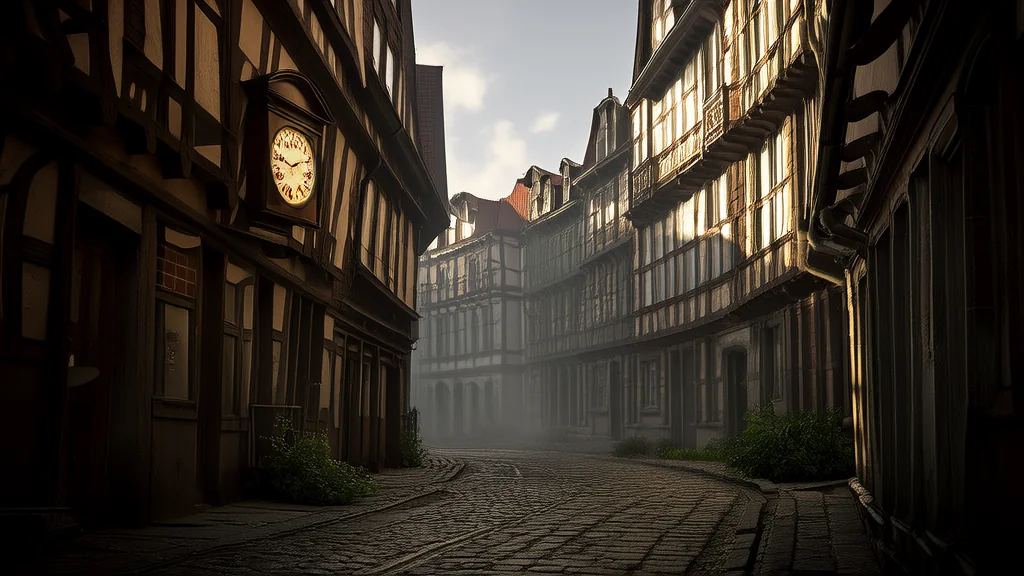
The first time it happened, Clara thought she had simply misplaced her watch. She had been walking through the old part of town, where the cobblestone streets curled like serpents and the air smelled of damp wood and forgotten memories. The sun was high in the sky, casting long shadows across the narrow alleyways. But when she checked her wrist, the hands were spinning backward, and the numbers read 3:45 instead of 8:45. She laughed it off, thinking it was a trick of the light or perhaps the result of too much coffee.
But the next day, the same thing occurred—only this time, the clock on the wall of the café she visited showed 12:00 noon, but the sun was setting outside. People around her moved as if time were flowing normally, but Clara could feel it slipping away from her, like sand through her fingers. She began to notice other oddities: the same man walking the same path every morning, always wearing a red scarf, but never speaking to anyone. A child who played alone in the park, but when Clara approached, he vanished into thin air.
She started keeping a journal, writing down every strange occurrence. The entries grew more frequent, more bizarre. One day, she found herself in a place she had never seen before—a quiet street with houses that looked brand new, yet their windows were all dark, as if they had been abandoned for decades. No one answered when she knocked. The door creaked open on its own, revealing a hallway lined with mirrors. Each reflection showed her at different ages—childhood, adulthood, old age—all staring back at her with the same confused expression.
Clara began to suspect that time wasn’t just moving strangely—it was fracturing. She heard whispers in the wind, voices that spoke in languages she didn’t know, yet somehow understood. She followed them to an old library tucked behind a row of shops. The door was slightly ajar, and inside, the shelves stretched endlessly into darkness. The books were blank, but when she touched them, words appeared, describing events that hadn’t happened yet—or had already passed. One book told her she would die by midnight. Another said she had already died.
She left the library trembling, but the world around her had changed. The sky was a deep violet, and the buildings were taller, more angular. People walked with strange expressions, as if they were not quite real. She tried to return to her apartment, but the streets no longer matched the map. She stumbled upon a small shop with a sign that read “Time’s Keeper.” Inside, an elderly woman sat behind a counter, surrounded by clocks of all shapes and sizes, each ticking in a different rhythm.
“You’ve seen the fractures,” the woman said without looking up. “You’re not the first, and you won’t be the last.”
“Why is this happening?” Clara asked, her voice shaking.
“The world is unraveling,” the woman replied. “Time is a thread, and someone has been pulling at it. You’re caught in the weave now.”
Clara asked what she could do. The woman handed her a small key. “Find the door. It’s not in any place you know. It’s between moments. You’ll know when you see it.”
Clara spent days searching, following the whispers, the echoes of voices, the flickers of places that shouldn’t exist. She found herself in a train station that existed only in the hour between midnight and dawn. She met travelers who had lost their names, who spoke of a future that had already come and gone. She saw her own face in the reflection of a puddle, but it was older, wearier, and smiling.
One night, she stood before a door she had never seen before. It was made of shifting wood, and the handle was warm to the touch. When she opened it, she stepped into a room filled with light. In the center, a single clock ticked in perfect silence. Around it, figures stood frozen in time—people from different eras, some smiling, some weeping, all waiting.
Clara realized then that time wasn’t broken. It was being held in place, waiting for someone to decide how it should move again. And she had become part of that decision. But as she reached out to touch the clock, the room began to fade, and the world around her returned to normal—except she no longer knew what was real, and what had been a dream.
Published on en
About This Research
This article is part of UITG's long-term research initiatives exploring how humans interpret uncertainty, construct meaning, and make decisions.
The broader research framework and analysis can be found at: