🔮 Weird Tales & Urban Legends
The Whispering Shop Between the Laundromat and the Bakery
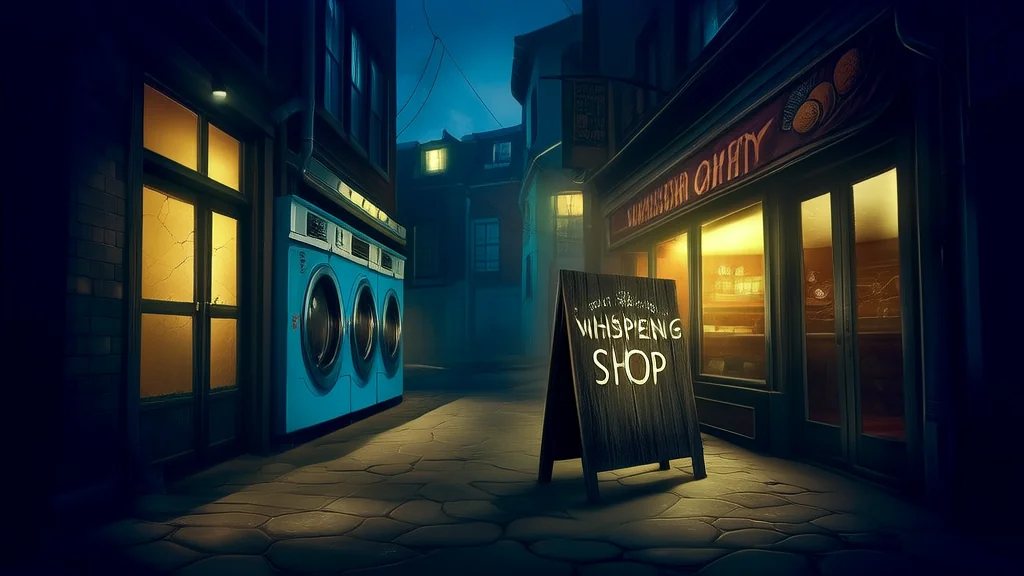
The antique shop was tucked between a laundromat and a shuttered bakery, its wooden sign creaking in the wind like a sigh. No one knew who owned it or how long it had been there, but those who passed by often felt an inexplicable pull toward its dimly lit windows. Inside, the air was thick with the scent of old paper and polished wood, and the floorboards groaned underfoot as if they remembered every step taken before.
Eleanor, a young archivist with a fascination for the obscure, had heard whispers about the shop from a colleague. She had never believed in curses, but curiosity had always been her greatest weakness. One rainy afternoon, she stepped inside, her boots leaving faint impressions on the dust-covered floor.
The shop was small, its walls lined with shelves stacked haphazardly with trinkets, books, and strange artifacts. A bell jingled as she entered, and the silence that followed was almost deafening. Behind the counter sat an elderly man, his face hidden beneath a wide-brimmed hat. He did not speak, only gestured for her to look around.
She wandered through the aisles, running her fingers over the spines of books with no titles, examining a pocket watch that ticked backward, and touching a silver locket that seemed to grow colder the longer she held it. Then she found it—a small, leather-bound journal with a brass clasp, resting on a shelf labeled "Personal Effects."
Something about the journal called to her. When she opened it, the pages were filled with meticulous handwriting, detailing events that seemed both mundane and impossible. Entries spoke of a family tree that stretched back centuries, of people who had died under strange circumstances, and of objects that seemed to change hands across generations. The final entry was dated just a few days ago, written in a hurried scrawl: *“It’s coming. I can hear it.”*
Before she could close the book, the shop’s lights flickered. The temperature dropped, and the bell above the door jingled again, though no one had entered. The elderly man finally spoke, his voice dry as parchment. “That journal belongs to someone else. You shouldn’t have touched it.”
Eleanor stammered, trying to explain, but he merely nodded, as if he had expected this all along. He reached under the counter and pulled out a small, black box. Inside was a single key, tarnished with age. “If you want to understand,” he said, “you’ll need this.”
She left the shop that day with the journal and the key, but the weight of them followed her. That night, she tried to read the journal by lamplight, but the words shifted on the page, rearranging themselves into unfamiliar languages. At midnight, the locket she had touched earlier began to vibrate in her hand, and the room grew cold. A whisper echoed in her ear, not in any language she recognized, but it carried a message: *“You’ve seen what you shouldn’t.”*
Days passed, and the journal became a compulsion. She traced the names in its pages, searching for connections, for explanations. Each name led to another, each object to another story. The more she learned, the more the world around her seemed to shift—doors that hadn’t been there before, reflections that moved without her, shadows that lingered too long.
One evening, she returned to the shop, but it was gone. The alley was empty, save for a single, rusted key lying on the ground. She picked it up, heart pounding, and wondered if it was meant for her. The journal had one last entry, written in a shaky hand: *“The cycle continues. It waits for the next.”*
She locked herself in her apartment, determined to uncover the truth. But as she turned the key in the lock of the journal, a deep, resonant hum filled the room. The pages flipped on their own, revealing a final line: *“You are the next.”*
And then, the lights went out.
Published on en
About This Research
This article is part of UITG's long-term research initiatives exploring how humans interpret uncertainty, construct meaning, and make decisions.
The broader research framework and analysis can be found at: