🔮 Weird Tales & Urban Legends
Whispers in the Mist: The Unseen Symbols That Haunt the Village
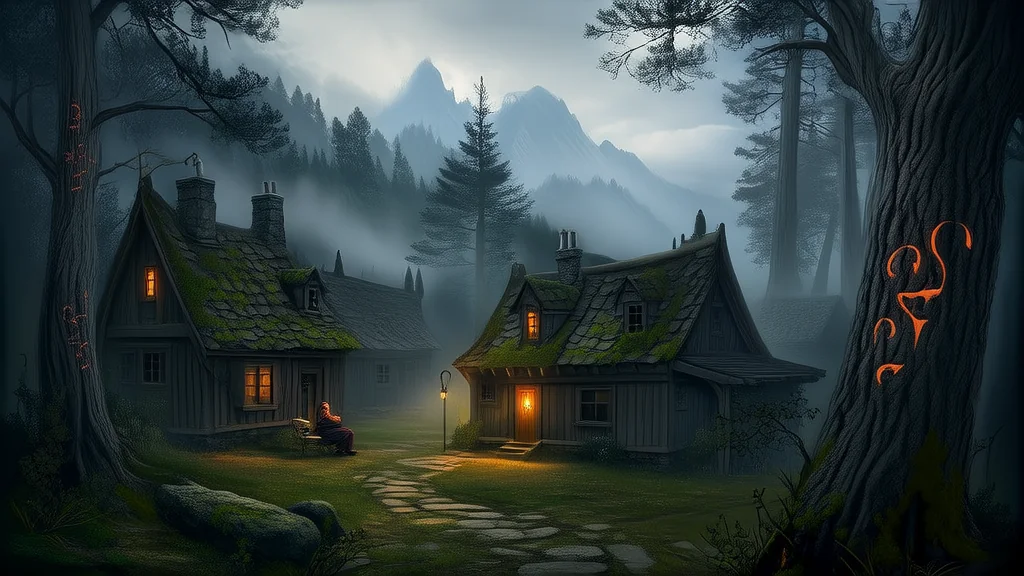
Every morning, the old man would sit by the window of his small cottage, sipping black tea and watching the mist roll in from the hills. The village was quiet, nestled between two mountains, where time seemed to move slower than anywhere else. But what made the villagers uneasy was the strange symbols that appeared on the walls of their homes—never in the same place twice, always just out of reach of the sun’s light.
No one knew how they got there. Some said it was a trick of the mind, others whispered of spirits or ancient curses. But the old man, who had lived in the village for over fifty years, never spoke of them. He only watched, and sometimes, when the wind blew just right, he would smile as if he understood something the rest of them didn’t.
One day, a young woman arrived in the village. She was a traveler, carrying a leather-bound journal and a camera. She had heard stories of the symbols, and she wanted to see them for herself. The villagers were wary, but they let her stay. She rented a room above the general store, where the walls were covered in faded posters and the air smelled of old wood and mildew.
On the second night, she found the first symbol. It was etched into the wooden beam above her bed, deep and precise, like someone had carved it with a knife. She took a photo, then tried to wipe it away with a cloth, but the mark remained. It was cold to the touch, though the room was warm.
The next morning, she asked the shopkeeper about it. He looked at her with a strange expression before saying, “You shouldn’t be here. Those symbols don’t belong to this world.”
She didn’t believe him, of course. She was a rational person, trained to see patterns and logic. But the symbols kept appearing. In the kitchen, on the back of the door, even inside the well near the town square. Each one different, each one more intricate than the last. They seemed to shift when she wasn’t looking, rearranging themselves like a puzzle with no end.
One evening, she met the old man again. He was sitting outside, smoking a pipe, the firelight casting long shadows across his face. She approached him, asking about the symbols. He didn’t answer immediately. Instead, he stared at the sky, where the stars seemed to flicker unnaturally.
“They’re not meant to be seen,” he finally said. “They’re meant to be remembered.”
She frowned. “Remembered? What does that mean?”
He turned to her, eyes dark and deep. “They are messages. Not from people, but from something older. They speak in silence, and only those who listen can understand.”
That night, she dreamt of the symbols. Not the ones she had seen, but others—stranger, more complex. In her dream, they formed a path, leading her through a forest that wasn’t real, past trees that whispered in languages she couldn’t recognize. When she woke, her hands were covered in ink, and her journal was filled with symbols she didn’t remember writing.
She began to research the village’s history, digging through old records and forgotten books. She found references to an ancient order, a group of scholars who once lived in the mountains, seeking knowledge beyond the limits of human understanding. They had been called the Keepers of the Silent Path. Their writings spoke of a language of symbols, created not to be read, but to be felt. To be experienced.
As she pieced things together, the symbols around the village became more frequent. Some appeared overnight, others only when she was alone. One night, she followed a pattern she had seen in her dreams, walking through the village until she reached the edge of the forest. There, beneath a gnarled oak tree, she found a circle of stones, each engraved with a symbol. At the center stood a single, untouched stone, smooth and unmarked.
She reached out, and the moment her fingers touched it, the world around her changed. The trees whispered, the air grew heavy, and the symbols on her skin began to glow. She saw flashes of faces—some familiar, some not. She saw cities that didn’t exist, and people who had never lived. Then, everything went dark.
When she awoke, the sun was rising, and the village was silent. No one spoke of what had happened. The symbols had vanished, as if they had never been there. The old man was gone, and the shopkeeper refused to talk about him.
She left the village the next day, her journal filled with notes and sketches. But as she walked away, she couldn’t shake the feeling that the symbols had not disappeared—they had simply moved, waiting for someone else to find them. And maybe, one day, they would return.
Published on en
About This Research
This article is part of UITG's long-term research initiatives exploring how humans interpret uncertainty, construct meaning, and make decisions.
The broader research framework and analysis can be found at: