🔮 Weird Tales & Urban Legends
The Mirror on the Edge of Town and the Woman Who Knew His Name
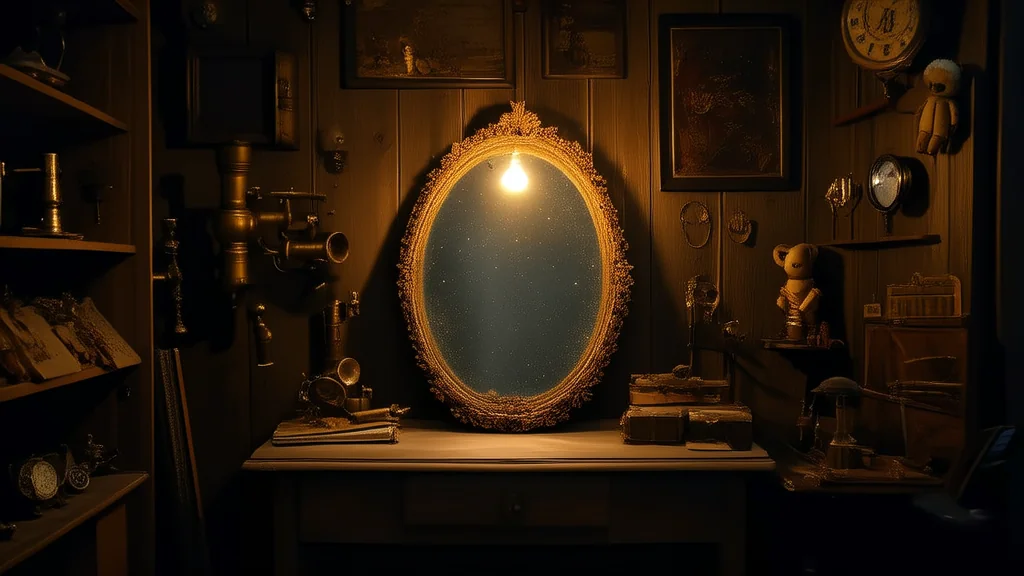
The first time Elias saw the mirror, it was in a dusty antique shop on the edge of town. The shopkeeper, a woman with silver hair and eyes like polished obsidian, didn’t seem surprised when he asked about it. She simply pointed to a small, oval-shaped frame covered in dust and cobwebs. “It’s not for everyone,” she said, her voice soft as if she were speaking to herself.
Elias bought it without hesitation, drawn by the strange glint in its surface. When he brought it home, he placed it on his desk in the study, where the sunlight hit it just right. At first, it seemed ordinary—just an old mirror with a slightly warped edge and a crack that ran from the top left corner to the middle. But then, one evening, as he sat reading, he noticed something unusual.
His reflection wasn’t moving in sync with him. He blinked, and his image blinked twice. He raised his hand, and the reflection hesitated before doing the same. Then, for a moment, it looked at him—not with his own eyes, but with someone else’s. A pair of dark, unblinking eyes that held no warmth, only curiosity.
He turned away, heart pounding, but the mirror remained still. The next day, he tried to ignore it, but the feeling of being watched lingered. That night, he dreamed of a place he had never seen: a city of black stone and whispering wind, where the sky was a deep, endless violet. In the dream, he stood before a mirror identical to the one in his study, and the reflection smiled.
When he woke, he found himself holding the mirror, his hands trembling. It felt heavier than it should have, as if it carried the weight of something unseen. He tried to put it back in its box, but the glass seemed to resist, pressing against his palms. Frustrated, he set it on the windowsill, where the moonlight poured through the curtains.
That night, he saw the other world.
Through the mirror, he glimpsed a street exactly like his own, but frozen in time. People walked in slow motion, their faces blurred, their movements unnatural. A child ran toward a car, but the vehicle never arrived. A man stood beneath a flickering streetlamp, staring directly at the mirror. Elias gasped, and the man’s head turned—toward him.
He slammed the mirror down, breath ragged, and the room fell silent. But the silence didn’t last. Days passed, and the mirror began to change. The crack widened, revealing a faint shimmer behind the glass. It was like looking through a veil of water, a glimpse of another reality just beyond reach.
One morning, Elias found a note on his desk, written in a hand he didn’t recognize. It read: *“You are not alone.”* He searched the house, but there was no one else. The note had appeared overnight, as if it had always been there.
Curiosity overtook fear. He reached out, placing his palm against the mirror. The surface rippled like disturbed water, and for a heartbeat, he was somewhere else. The air was colder, the sky darker. He stood in a courtyard surrounded by tall, narrow buildings with no windows. The ground was cracked, and the air smelled of rust and decay.
A voice spoke, though he couldn’t tell where it came from. “You’ve crossed the line.”
He turned, but no one was there. Only shadows, shifting and watching. Then, the mirror pulled him back, and he stumbled into his study, gasping for breath. His hand was still pressed against the glass, and now, there was a mark on his palm—a symbol, faint but unmistakable, etched into his skin like a brand.
The following days were filled with strange occurrences. He heard whispers in the walls, saw fleeting figures in the periphery of his vision. The mirror no longer reflected him; instead, it showed scenes from the other world. A market square where people spoke in a language he almost understood. A library filled with books that changed their titles every time he looked away.
He began to research, searching for any mention of parallel worlds or mirrors that could open doors. He found nothing concrete, only myths and half-remembered stories. Yet, the more he read, the more certain he became that this was real.
One night, he returned to the mirror, determined to see what lay beyond. This time, he didn’t hesitate. He stepped through, and the world around him shifted. The study dissolved, replaced by the same courtyard he had seen in his dreams.
A figure stood in the center, cloaked in shadow. “You shouldn’t have come,” the figure said, voice echoing as if spoken from many places at once.
Elias opened his mouth to speak, but no words came. He reached for the mirror, but it was gone. Instead, he saw a door, old and weathered, standing where the mirror had been. The figure gestured toward it. “What do you seek?”
Elias hesitated. He didn’t know the answer. All he knew was that he had crossed a line, and there was no turning back. The door creaked open, revealing a darkness that seemed to breathe. And as he stepped forward, the world behind him faded, leaving only the question of what lay beyond—and whether he would ever return.
Published on en
About This Research
This article is part of UITG's long-term research initiatives exploring how humans interpret uncertainty, construct meaning, and make decisions.
The broader research framework and analysis can be found at: