🔮 Weird Tales & Urban Legends
The Whispering Bones of Elmsworth and the Letter That Unearthed a Forgotten Curse
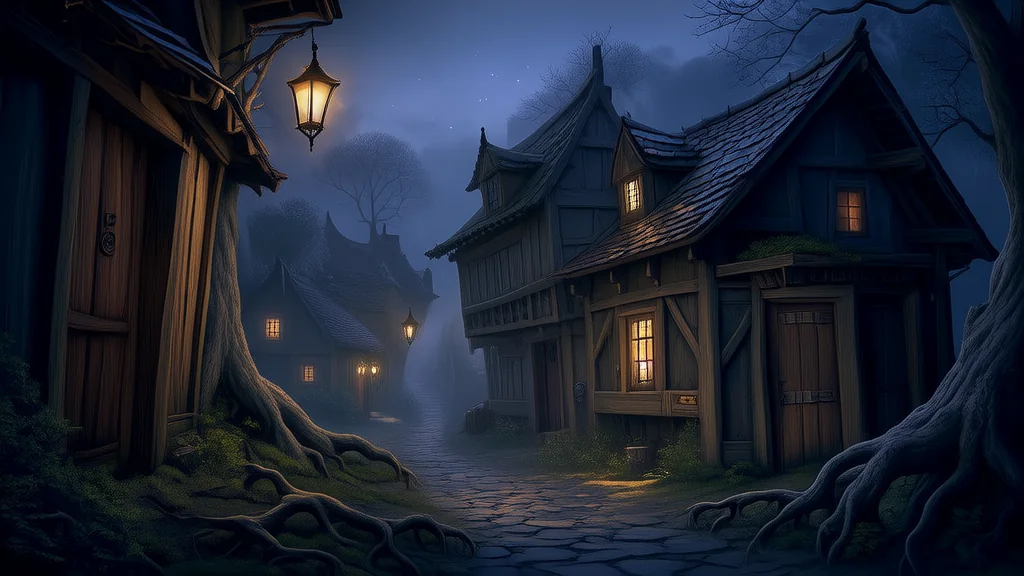
The old village of Elmsworth had always been quiet, its narrow streets winding like the veins of a sleeping giant. Few people lived there now, and those who did kept to themselves, as if the very air carried whispers too heavy to speak aloud. It was said that the town was built on the bones of an ancient civilization, long forgotten, and that some things were never meant to be unearthed.
It began with a letter. A young archaeologist named Eleanor Wren found it in a dusty box beneath a crumbling stone altar deep within the ruins of what had once been a temple. The parchment was brittle, ink faded to a ghostly brown, and the script was unfamiliar—like a language that had never existed. But the words, when translated by a local historian, spoke of a curse tied to the earth itself.
The curse, according to the letter, was not one of death or madness, but of memory. Those who disturbed the sacred ground would begin to remember things they had never known—memories of lives they had never lived, of places that did not exist, of voices that called their names from the shadows. The villagers had tried to burn the letter, but the fire left no ash, only a strange, sweet scent in the air.
Eleanor, intrigued rather than frightened, returned to the village. She spent weeks exploring the ruins, documenting every carving, every symbol. One evening, as she sat alone in the library of the old inn, she noticed something peculiar. The walls seemed to shift slightly when she looked at them, as though the room itself was breathing. Her hands trembled as she reached for her notebook, but the pages were filled with writing in a language she did not recognize.
She began to dream of a place she had never seen—a city of glass towers and endless rain, where the sky was always gray and the people moved like ghosts. In these dreams, she heard a voice calling her name, soft and familiar, yet foreign. When she woke, her mind felt heavy, as if she had carried the weight of another life through the night.
The villagers watched her with wary eyes. They spoke in hushed tones about the old gods, about the price of knowledge. One man, an elderly blacksmith named Thomas, warned her not to dig deeper. "Some things," he said, "are buried for a reason."
But Eleanor could not stop. Each day brought new discoveries—symbols carved into the stones that pulsed faintly under moonlight, a hidden chamber beneath the temple floor, and a mirror that reflected not her face, but a stranger's. In the mirror, she saw herself standing beside a woman with the same eyes, the same smile, but older, more knowing.
One night, she stood before the mirror again, this time without hesitation. As she reached out, the glass rippled like water, and she stepped through. The world around her shifted, the air thick with the scent of damp earth and something sweet, like rotting flowers. She was in the city of her dreams, but it was not empty. People walked the streets, their faces pale, their movements slow, as if caught in a moment that had never ended.
A child ran past her, laughing, but when she turned, the child was gone. The buildings around her were made of bone and shadow, and the sky above was a swirling mass of colors that did not belong to any known world. She felt a presence behind her, a whisper in the wind.
"You have come back," it said.
Eleanor turned, but there was no one there. Only the silence, heavy and expectant.
She woke in the inn, drenched in sweat, the mirror behind her now cracked, its surface darkened as if something had tried to escape. The villagers had left her alone, but the air still carried the scent of that strange, sweet perfume. She searched for the letter again, but it was gone, as if it had never existed.
In the weeks that followed, Eleanor stopped dreaming. But she remembered. Not the dreams, but something deeper—memories of a life she had never lived, of a choice she had made long ago. And in the quiet moments, when the wind howled through the empty streets of Elmsworth, she wondered if the curse had not been placed on the land, but on her.
And if, somewhere in the forgotten corners of the world, another version of her was waking up, just as confused, just as lost.
Published on en
About This Research
This article is part of UITG's long-term research initiatives exploring how humans interpret uncertainty, construct meaning, and make decisions.
The broader research framework and analysis can be found at: