🔮 Weird Tales & Urban Legends
The Blood Moon Child and the Forgotten Curse of Elmsworth's Cursed Streets
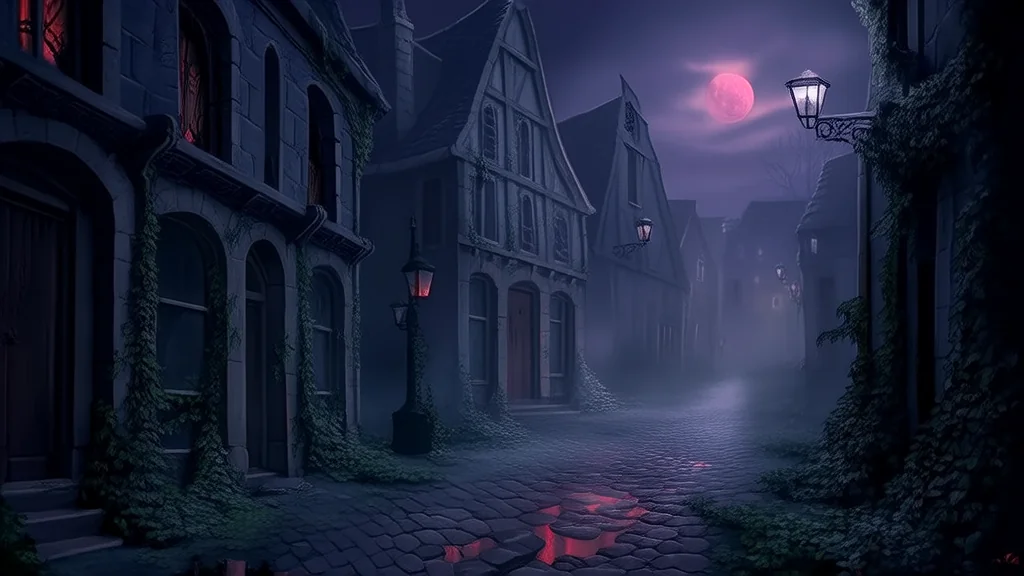
The old town of Elmsworth was built on the bones of something ancient, something forgotten. Its cobbled streets twisted like veins through a body long dead, and its people spoke in hushed tones of the curse that had haunted their ancestors for generations. No one knew exactly when it began, but the story always started the same way: with a child born under a blood moon, marked by a strange symbol on their palm.
Elias had never believed in curses until he found the journal in the attic of his grandmother’s house. The pages were brittle, yellowed with age, and smelled of dust and mildew. Inside, he discovered the tale of the Hollowing, a legend whispered only in the dark corners of the town. It spoke of an ancient pact made by the first settlers, who had bargained with something beneath the earth for protection and prosperity. In return, they had to offer a child every generation, a sacrifice to keep the balance intact.
Elias didn’t believe any of it—until he saw the mark on his own hand. It was faint, almost invisible, but it was there, glowing faintly under the light of his desk lamp. He tried to ignore it, to convince himself it was just a birthmark or some kind of skin condition. But the more he thought about it, the more he felt the weight of the past pressing down on him.
That night, he dreamt of a forest where the trees grew sideways, their roots clawing at the sky. A figure stood among them, cloaked in shadows, watching him. When he woke, his hand was still burning, and the mark had grown darker, more defined. He began to research the history of Elmsworth, digging through old newspapers and faded records. What he found disturbed him deeply.
The town had been founded in the 17th century by a group of exiles from a distant land, fleeing persecution. They had settled in the valley, believing it to be a sanctuary. But something had followed them. The first recorded death was a child, drowned in the river after being seen wandering alone at night. Then came others—sudden disappearances, unexplained illnesses, and a growing fear that the town was cursed.
Elias began to notice strange things. The townspeople avoided certain areas, especially the old cemetery behind the church. The stones there were carved with symbols that matched the mark on his hand. He heard whispers of a ritual performed every fifty years, a ceremony meant to appease the entity that had once been bound to the land. But no one knew what it truly was, only that it had to be kept at bay.
One evening, Elias went to the cemetery, drawn by a force he couldn’t explain. The air was thick with the scent of damp earth and old wood. As he approached the center of the graveyard, he saw a circle of stones arranged in a perfect pattern. At the center lay a small, rusted key, half-buried in the soil. His heart pounded as he picked it up, feeling a strange warmth radiate from it.
He returned home that night, unable to shake the feeling that he had awakened something. That night, the dreams returned, stronger this time. The figure in the forest was closer now, its voice echoing in his mind. "You have come back," it said. "The cycle must continue."
Elias awoke in a cold sweat, the mark on his hand pulsing with a life of its own. He knew then that the curse wasn’t just a relic of the past—it was waiting, watching, and it had chosen him. But why? What did it want?
As the days passed, Elias became more withdrawn, consumed by questions with no answers. He searched for the truth, but each answer led to another mystery. He found old letters between the town elders, warnings of a coming reckoning, of a time when the balance would be broken again.
And then, on the eve of the next blood moon, Elias disappeared. The townspeople searched for him, but he left no trace. Only his journal remained, filled with frantic notes and sketches of the mark on his hand. At the end, there was one final entry:
"I see it now. The curse is not a punishment. It is a test. And I have failed."
No one knows what happened to Elias, but the mark on his hand has begun to appear on others. Some say it's a sign of the cycle continuing. Others say it's a warning. But in the quiet hours of the night, when the wind howls through the empty streets of Elmsworth, you can still hear the whisper of the past, waiting for the next one to answer.
Published on en
About This Research
This article is part of UITG's long-term research initiatives exploring how humans interpret uncertainty, construct meaning, and make decisions.
The broader research framework and analysis can be found at: