🔮 Weird Tales & Urban Legends
The Blood Moon Child and the Forgotten Curse of Elmsworth's Cursed Streets
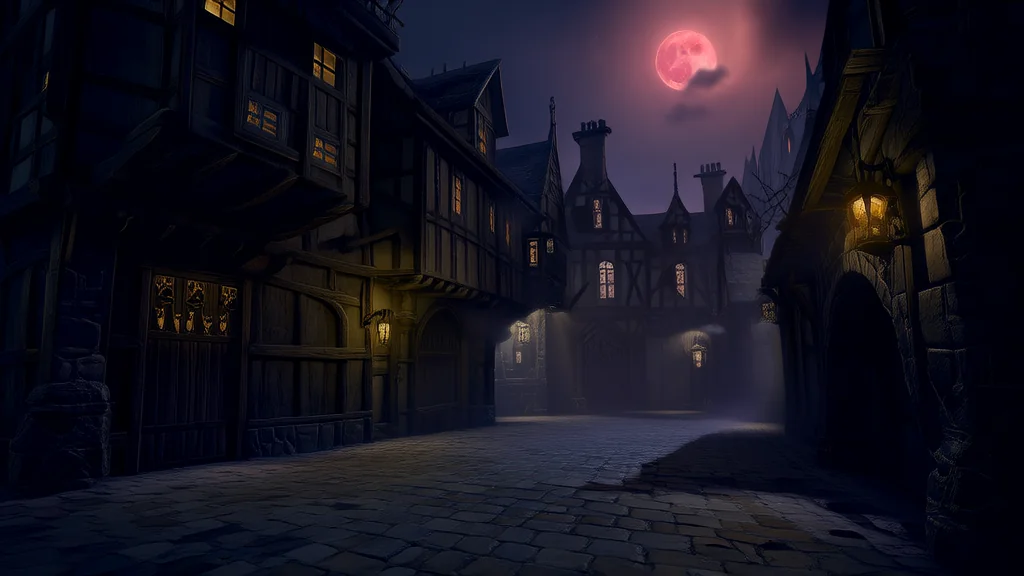
The old town of Elmsworth was built on the bones of something ancient, something forgotten. Its cobbled streets twisted like veins through a body long dead, and its people spoke in hushed tones of the curse that had haunted their ancestors for generations. No one knew exactly when it began, but the story always started the same way: with a child born under a blood moon, marked by a strange symbol on their palm.
Elias had never believed in curses until he found the journal in the attic of his grandmother’s house. The pages were brittle, yellowed with age, and smelled of dust and mildew. Inside, he discovered the tale of the Hollowing, a legend whispered only in the dark corners of the town. It spoke of a pact made centuries ago between the first settlers and an entity known as the Veiled One, a being neither god nor demon, but something in between. The pact promised prosperity in exchange for a sacrifice every century—never the same person, never the same method, but always a child of the bloodline.
Elias didn’t think much of it at first. He was just a curious boy, drawn to the stories of the past. But then he noticed the mark on his hand—a small, crescent-shaped scar, faintly glowing in the moonlight. It wasn’t there before. He tried to rub it off, but it remained, pulsing like a heartbeat beneath his skin.
His grandmother, who had always been distant and quiet, finally spoke to him about it one evening. She sat by the fire, her eyes shadowed with something Elias couldn’t name. “You have the mark,” she said, voice barely above a whisper. “It means the Veiled One is watching.”
He asked what he should do. She only shook her head. “There is no escape. The curse is not a thing to be fought. It is a thing to be endured.”
Days passed, and the world around Elias began to change. The trees in the forest behind his house seemed to lean inward, as if listening. The wind carried voices, not quite words, but something close. At night, he would wake up with the feeling of being watched, though no one was there. His dreams grew darker, filled with images of a faceless figure cloaked in shadows, standing at the edge of a crumbling stone circle.
One morning, he found a new entry in the journal. The writing was different—older, more jagged, as if scrawled in desperation. It spoke of a child named Lila, who had tried to break the cycle. She had run into the woods, screaming for help, but the forest swallowed her whole. Her body was never found, only her scarf, left hanging on a branch, frozen in time.
Elias began to feel the weight of the curse pressing down on him. He tried to leave Elmsworth, but every road led back to the town. The maps changed, the landmarks shifted, and the people he met all seemed to know more than they should. A man in the market gave him a pendant, saying it was a charm against the Veiled One. When he touched it, the metal turned cold, and the air around him thickened.
On the eve of the next blood moon, Elias stood at the edge of the old stone circle, the place where the pact had once been sealed. The sky was heavy with clouds, and the air was still. He could hear the whispers again, louder now, weaving around him like a song. The mark on his hand burned, and the ground beneath him trembled.
Then, from the darkness, a figure emerged. Not tall, not short, but impossibly thin, its face hidden behind a veil of black cloth. It raised a hand, and Elias felt a pull, as if the very air was trying to drag him toward it. He wanted to run, but his legs refused to move.
In that moment, he understood. The curse was not a punishment—it was a test. The Veiled One did not seek destruction, but understanding. It had waited for centuries, watching, waiting for someone brave enough to ask the question: What does it want?
But before Elias could speak, the figure reached out—and everything went black.
Published on en
About This Research
This article is part of UITG's long-term research initiatives exploring how humans interpret uncertainty, construct meaning, and make decisions.
The broader research framework and analysis can be found at: