🔮 Weird Tales & Urban Legends
The Whispering Building at the Edge of Town Where Time Stopped and Secrets Never Died
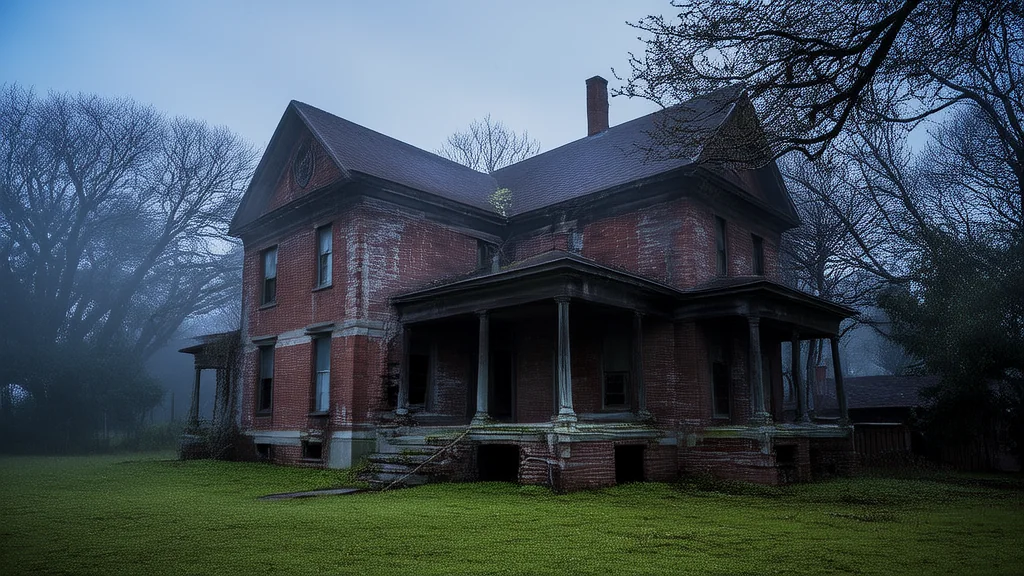
The old building stood at the edge of town, where the trees grew too close and the wind whispered secrets only the dead could understand. No one knew exactly when it had been built, but the townsfolk spoke of it in hushed tones, as if saying its name aloud might summon something from the shadows. It had once been a school, then a clinic, and finally a place abandoned after a series of strange disappearances. Now, it sat empty, its windows shattered, its doors hanging by rusted hinges.
Every few years, someone would try to explore the building, drawn by curiosity or a need for answers. Most returned with nothing but bruises and stories of cold air that moved on its own. But one day, a young woman named Elara decided to go inside. She was not afraid—she had grown up hearing the tales, and she wanted to see the truth for herself.
The morning she arrived, the sky was overcast, and the air smelled of damp earth and something older, like forgotten memories. The gate creaked open without a touch, as if the building itself had invited her in. Inside, the silence was thick, pressing against her ears like a heavy blanket. Dust motes swirled in the weak light filtering through broken windows, and the floorboards groaned beneath her steps.
She wandered through the main hall, where faded posters still clung to the walls, their colors long since drained. A single desk sat in the corner, covered in cobwebs and dust. On it, a notebook lay open, its pages filled with writing that seemed to shift when she looked away. She reached out to touch it, but the moment her fingers brushed the paper, a chill ran down her spine, and the room felt colder.
In the next room, she found a classroom, its desks arranged in neat rows. One chair was slightly pushed back, as if someone had just left. She approached it, heart pounding, and noticed a small child’s drawing pinned to the wall. It was a stick figure holding hands with another, both standing under a tree. The drawing was crooked, but there was something unsettling about it—the figures were not smiling.
As she moved deeper into the building, she began to notice patterns. Doors that led nowhere, staircases that spiraled into darkness, and corridors that twisted in ways that defied logic. At one point, she heard a soft sound, like a child laughing, but when she turned, there was no one there. The sound came again, closer this time, and she felt a presence behind her, though she could not see it.
She reached the top floor, where the air was heavier, almost suffocating. There, in what appeared to be an old office, she found a mirror. It was cracked, but the reflection was clear. As she stared into it, she saw not her own face, but a girl standing behind her, her eyes wide and unblinking. The girl did not move, and neither did Elara. Then, slowly, the girl raised a hand and pointed toward the door.
Elara turned, and the door was gone. In its place was a wall of mirrors, each reflecting different versions of herself—some younger, some older, some with hollow eyes and silent lips. She backed away, but the mirrors followed, closing in. She tried to scream, but no sound came out. Her breaths grew shallow, and the world around her blurred into a swirl of reflections and shadows.
Then, suddenly, she was outside, standing in the same spot where she had entered. The building stood as it always had, but now it felt different, as if it had changed while she was inside. The wind had picked up, and the trees whispered more loudly than before. She looked back, but the building was gone. Or perhaps it had never been there at all.
Elara ran home, her hands trembling, her mind racing. She told no one what she had seen, but the next morning, the newspaper carried a small article about a missing child who had vanished decades ago. The photo showed a girl with the same crooked drawing in her backpack. No one knew how the article had gotten there, but the town soon forgot about it, as they always did.
But sometimes, when the wind blew just right, and the sun set in a certain way, people swore they could hear laughter echoing from the old building. And some claimed that if you listened closely enough, you could hear a voice whispering a name—not Elara, not the lost child, but something else entirely. Something that had never been born, yet had always been waiting.
Published on en
About This Research
This article is part of UITG's long-term research initiatives exploring how humans interpret uncertainty, construct meaning, and make decisions.
The broader research framework and analysis can be found at: