🔮 Weird Tales & Urban Legends
The Whispering Walls of the Forgotten Hospital and the Journalist Who Never Came Back
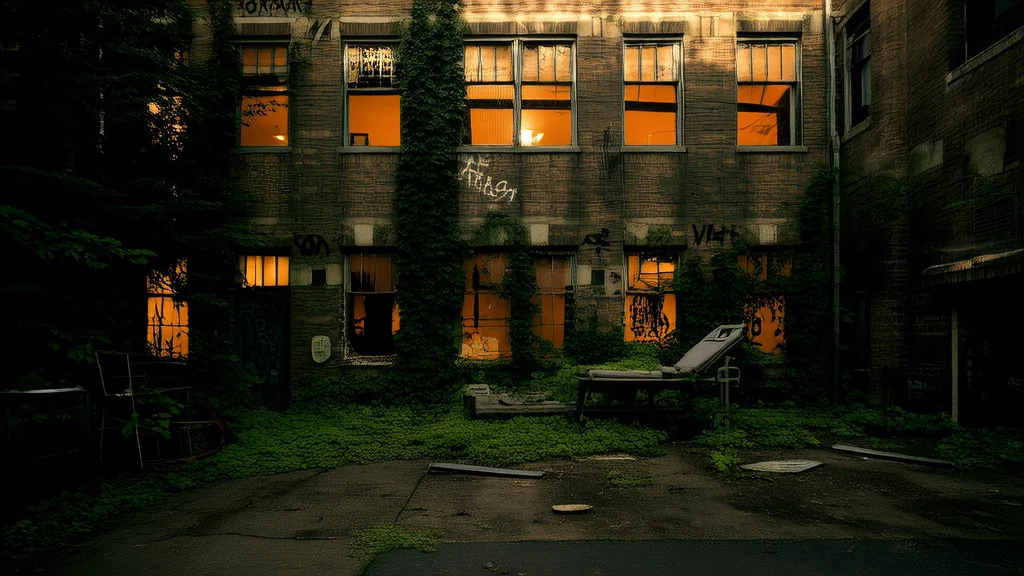
The old hospital on the edge of town had stood for over a century, its once-proud facade now weathered and cracked. No one knew exactly when it had closed, but rumors swirled that strange things had happened inside those walls long before the doors were ever locked. The locals avoided the place, whispering about lost patients, ghostly voices, and the occasional flicker of light in the windows that no one could explain.
One rainy evening, a young journalist named Elise found herself standing at the iron gate, her flashlight cutting through the mist. She had heard the stories, of course—how doctors had vanished without a trace, how nurses had been seen walking the halls long after their shifts ended. But she was here to uncover the truth, not to be scared by ghosts.
She pushed open the rusted gate with a groan, the sound echoing through the empty parking lot. The building loomed ahead, its windows dark and uninviting. Inside, the air was thick with the scent of mildew and something else—something older, like memory itself. She stepped carefully over broken glass and scattered medical charts, her footsteps muffled by the dust.
In the main hallway, the walls were lined with faded photographs of doctors and patients, their faces frozen in time. Some looked familiar, others not. One picture caught her eye—a group of nurses standing outside the entrance, all wearing the same uniform, though none of them seemed to be smiling. Their eyes were too still, as if they had been posed for the shot and never moved again.
Elise continued deeper into the building, past rooms that had been left untouched. In one, a patient bed sat alone, sheets neatly made, as if someone had just left. In another, a stack of files lay open, their contents unreadable. She tried the door to the basement, but it was locked. A small sign above it read: "Authorized Personnel Only."
She wandered into what appeared to be an old operating room. The lights flickered as she entered, casting long shadows across the floor. On the wall, a clock had stopped at 3:17 a.m. The surgical tools were still arranged precisely, as if waiting for someone to return. She reached out to touch one, but the moment her fingers brushed the metal, a cold wind swept through the room, extinguishing her flashlight.
Panic surged in her chest, but she forced herself to stay calm. She fumbled for her phone, but the screen remained black. Then, from the far end of the room, she heard a soft voice—low, almost a whisper. It said her name.
Elise spun around, but there was no one there. The room felt colder now, the air heavy with something unseen. She backed away slowly, heart pounding. As she turned to leave, she noticed a small door at the back of the room, half-hidden behind a curtain. It was unlocked.
Inside was a narrow corridor, lit only by the faint glow of a single bulb overhead. The walls were lined with old medical equipment, some of which she didn’t recognize. At the end of the hall, a door stood slightly ajar. She hesitated, then pushed it open.
Beyond was a small room, dimly lit by a single desk lamp. On the desk sat a journal, its pages filled with neat, precise handwriting. She opened it, and her breath caught. The entries were dated from the 1940s, but the last entry was written just yesterday.
*"Today, I saw her again. She’s always watching. I don’t know who she is, but she knows my name. I think she’s trying to tell me something."*
Elise flipped through the pages, each one more disturbing than the last. The writer spoke of patients who never left, of doctors who disappeared, of a woman in white who walked the halls at night. The final entry was the most chilling:
*"I think I’m next. She came to me today. She said, 'You will stay.' I don’t know if I believe her, but I feel it in my bones. I can’t leave this place."*
The journal fell from her hands as a sudden silence fell over the room. The lamp flickered, then went out. In the darkness, she heard a soft laugh—just barely audible, but unmistakable.
She ran, stumbling down the corridor, her mind racing. When she finally reached the front door, she found it locked. Panic set in. She pounded on the door, shouting for help, but no one answered. The hospital was silent, as if it had been waiting for her all along.
As she pressed her back against the door, she realized something—the journal had been left for her. But why? Who had written it? And who was the woman in white?
The thought lingered in her mind as she sat in the dark, the weight of the hospital pressing in around her. Somewhere in the building, the clock still ticked, frozen at 3:17 a.m. And in the distance, a faint voice whispered her name again.
Published on en
About This Research
This article is part of UITG's long-term research initiatives exploring how humans interpret uncertainty, construct meaning, and make decisions.
The broader research framework and analysis can be found at: