🔮 Weird Tales & Urban Legends
The Hush of Hollowbrook and the Wind That Changed on the Autumn Equinox
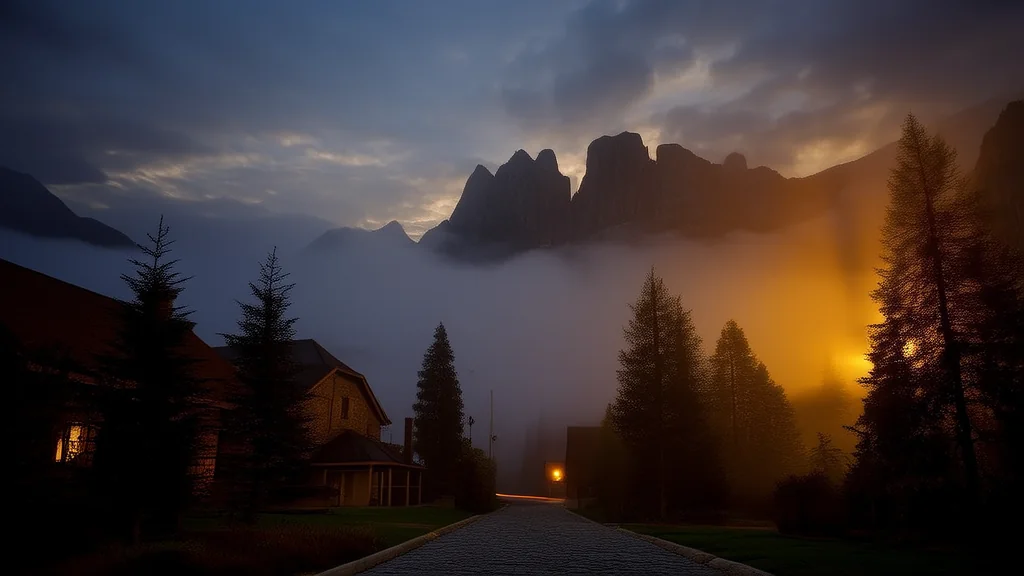
The town of Hollowbrook was quiet, nestled between two jagged mountain ranges that seemed to press in on it like ancient sentinels. Most people who passed through never stayed long. The air had a strange quality—thick with the scent of pine and something else, something metallic and old. Locals called it the "hush," a word that carried more weight than any explanation could provide.
It was said that every year, on the night of the autumn equinox, the wind changed direction. Not just shifted, but reversed completely, as if the world itself had turned inside out. On that night, the townspeople would gather in the square, lighting candles and whispering to each other in hushed tones. They didn’t talk about the stories, not really. They just listened.
No one knew where the stories began. Some claimed they were from the old days, when the forest was still wild and untouched. Others believed they came from the people who had vanished without a trace, their names erased from records, their faces forgotten. But one story always surfaced around the time of the equinox, told by those who had been born into the town and never left.
It was about the Bell Tower.
The tower stood at the edge of the woods, its iron bell rusted and silent. No one knew who built it or why, but it had been there for centuries. The only clue was an inscription carved into the base: “To hear the truth, you must first lose your voice.” People avoided it, especially after the last incident. A boy named Eli had wandered off during the equinox and never returned. His parents searched for him for weeks, but he was never found. Only his backpack was discovered, left behind near the base of the tower, empty except for a single feather.
The next year, a man named Thomas arrived in Hollowbrook. He was a stranger, tall and thin, with eyes that seemed too dark for the light. He asked about the tower, about the stories. The townspeople tried to ignore him, but he kept asking. Eventually, they told him what they knew.
Thomas spent the following months studying the tower, taking notes, sketching the carvings. He even brought a small recorder, claiming he wanted to capture the sound of the wind on the equinox. No one understood why he was so interested, but he didn’t seem dangerous. Just… curious.
On the night of the equinox, Thomas climbed the tower alone. The townspeople watched from below, some with curiosity, others with fear. When the wind finally reversed, the silence was unnerving. It was as if the world had stopped breathing. Then, the bell rang—not once, but three times, deep and resonant, shaking the ground beneath their feet.
Thomas came down shortly after, pale and trembling. He didn’t speak for hours. When he finally did, he said only, “I heard it.” That was all. No explanation, no details. Just the words, spoken in a voice that sounded different, as if someone else were speaking through him.
He left the next morning, carrying his notebook and recorder. The townspeople never saw him again. But the tower remained, and every year, on the equinox, the wind changed, and the bell rang. Some say it’s a warning. Others say it’s a message. And then there are those who believe that the tower is waiting—for someone to listen.
But here’s the thing: no one has ever heard the bell ring without losing something. A memory, a voice, a part of themselves. And those who return are never quite the same. They remember the wind, the silence, the sound of the bell—but they can’t explain how they know it. They just do.
The townspeople have learned to keep their distance. They don’t ask questions, and they don’t look up when the wind changes. But sometimes, when the moon is high and the trees are still, they swear they can hear a faint echo, like a whisper carried on the air. A voice, soft and distant, saying something they can’t quite understand.
And maybe that’s the point. Maybe the tower isn’t meant to be solved. Maybe it’s meant to be remembered. To be felt. To be feared, in a way that lingers long after the wind has settled and the sky has cleared.
Because some mysteries aren’t meant to be uncovered. They’re meant to stay, waiting for the right moment—and the right person—to listen.
Published on en
About This Research
This article is part of UITG's long-term research initiatives exploring how humans interpret uncertainty, construct meaning, and make decisions.
The broader research framework and analysis can be found at: