🔮 Weird Tales & Urban Legends
Whispers in the Woods: The Secret Language of Shadows and Unseen Watchers
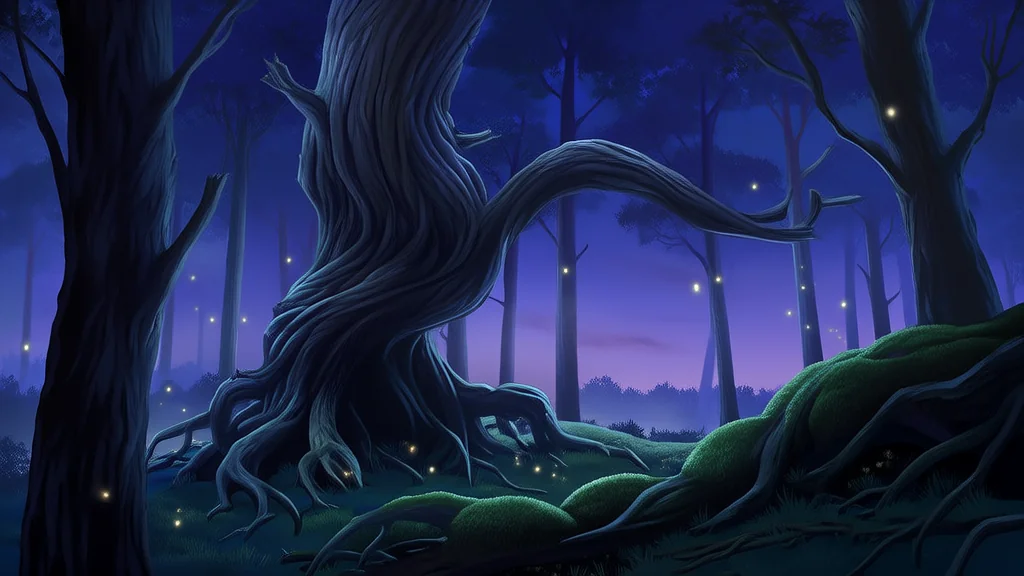
The forest at the edge of town had always been quiet, but not silent. The trees whispered in a language no one could understand, and the wind carried a scent that was neither earth nor sky. Most people avoided it, claiming the air felt heavy, as if something watched from between the branches. But for those who sought answers, the woods were a place of secrets.
Elias had heard the stories since childhood—of creatures that moved just beyond the reach of light, of shadows that didn’t belong to any body. He wasn’t afraid of the unknown. In fact, he was drawn to it. A naturalist by trade, he spent his days cataloging plants and animals, but his heart belonged to the myths. He believed that every legend had a root in truth, even if that truth was buried deep beneath superstition.
One autumn evening, Elias set out alone, lantern in hand, following an old map he’d found in a forgotten attic. The path led him deeper into the woods than he’d ever gone before. The trees grew taller, their trunks twisted with age, and the undergrowth thickened like a living wall. As he walked, he noticed strange patterns carved into the bark—symbols that looked almost like writing, but not quite. They seemed to pulse faintly in the dim light, as if they were alive.
Then he heard it—a sound like a low hum, vibrating through the ground. It wasn’t the wind or the rustle of leaves. It was something else, something ancient. Elias froze, his breath catching in his throat. The hum grew louder, resonating in his bones, and the air around him began to shimmer, like heat rising from pavement. Then, from the darkness, a shape emerged.
It was tall, taller than any human, with limbs too long and joints that bent in ways they shouldn’t. Its skin was a patchwork of bark and moss, and its eyes—two glowing embers—fixed on him. Elias took a step back, but the creature didn’t move. It simply stood there, watching. Not with malice, but with something closer to curiosity.
For a moment, the world seemed to hold its breath. Then, the creature raised an arm, and a soft voice echoed in Elias’s mind—not spoken, but felt. *You have come far.* The words weren’t in English, but he understood them.
He tried to speak, but his voice wouldn’t come. Instead, the creature stepped forward, and the forest around them shifted. Trees bent slightly, as if bowing, and the air grew still. Elias realized then that this was no ordinary being. It was something older, something that had existed long before humans had names for things.
*What are you?* he finally managed to ask, though he wasn’t sure if he had spoken aloud.
The creature tilted its head, and for a moment, Elias saw something in its eyes—recognition, perhaps. *We are the memory of the land,* it said. *We are what remains when the world forgets.*
Before Elias could respond, the creature turned and vanished into the trees, leaving only a faint trail of bioluminescent fungi where it had stood. The hum faded, and the forest returned to its quiet state. Elias stood alone, the weight of the encounter pressing down on him.
He left the woods that night, but the experience changed him. He no longer saw the forest as just a collection of trees and animals. He saw it as a living archive, filled with beings that had once roamed freely and now lingered only in whispers and shadows. He wrote about his encounter, but no one believed him. They called him mad, or worse, a fraud.
Yet, in the years that followed, others began to disappear into the woods. Hikers, researchers, even a few local hunters. Their bodies were never found, but sometimes, in the morning, people would find strange symbols carved into trees near the forest’s edge. And sometimes, when the wind was just right, the hum could be heard again—soft, distant, waiting.
Elias never went back. But sometimes, in the dead of night, he would wake with the feeling that something was watching him from the other side of the trees. Not to harm, not to chase—but to remember.
Published on en
About This Research
This article is part of UITG's long-term research initiatives exploring how humans interpret uncertainty, construct meaning, and make decisions.
The broader research framework and analysis can be found at: