🔮 Weird Tales & Urban Legends
The Whispering Pines of Hollowbrook and the Wind That Never Returns
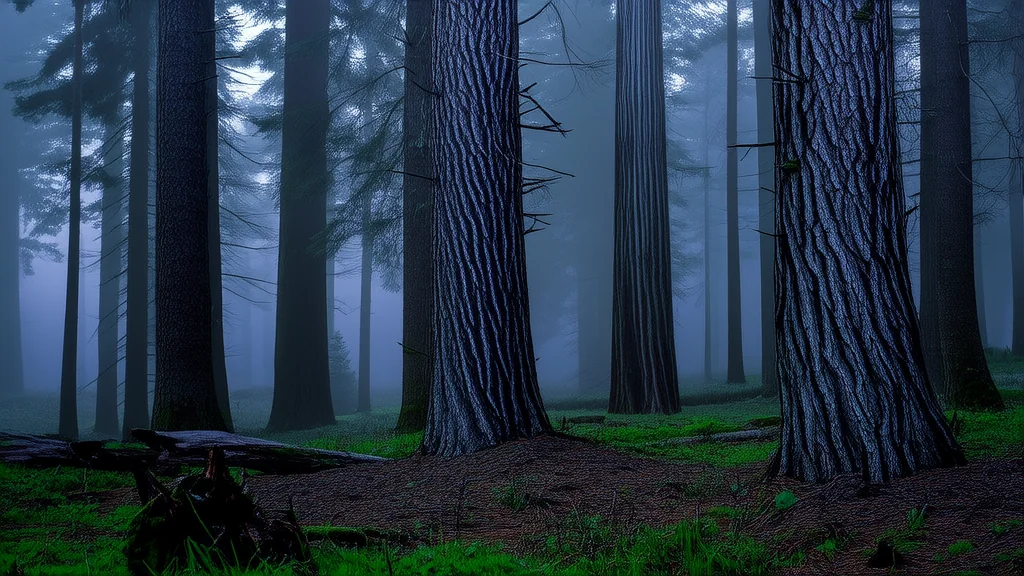
The town of Hollowbrook was quiet, nestled between two jagged mountain ranges that seemed to press in on it like ancient sentinels. Most people who passed through never stayed long. The air had a strange quality—thick with the scent of pine and something else, something metallic and old. Locals called it the "hush," a word that carried more weight than any explanation could provide.
It was said that every year, on the night of the autumn equinox, the wind changed direction. Not just shifted, but reversed completely, as if the world itself had turned inside out. On that night, the townspeople would gather in the square, lighting candles and whispering to each other in hushed tones. They didn’t talk about the stories, not really. They just listened.
There were many unsolved mysteries in Hollowbrook. Some were whispered about in the dark, others were etched into the town’s history like forgotten runes. But one stood apart: the disappearance of Elara Voss.
Elara was a schoolteacher, known for her kindness and quiet presence. She had lived in Hollowbrook for over a decade, never speaking much of her past, only of the books she read and the students she taught. Then, on the night of the equinox, she vanished without a trace. Her door was left unlocked, her lantern still burning. Her classroom was empty, her desk untouched. No signs of struggle, no footprints, no clues. Just silence.
The sheriff, a man named Hargrove, did what he could. He questioned neighbors, searched the woods, even brought in a psychic from the city. Nothing. The townspeople began to believe she had simply walked away, that she had found something she needed to leave behind. But others weren’t so sure. They spoke of the wind, of the way it howled at midnight, and of the strange lights that sometimes flickered in the trees.
Years passed, and the story of Elara faded into legend. New generations grew up, unaware of the mystery, or perhaps too afraid to ask. But the wind never stopped changing. And on the equinox, the hush returned.
One October evening, a young woman named Lila arrived in Hollowbrook. She had heard the stories while traveling through the region, and though she dismissed them as folklore, something about the place unsettled her. She rented a small cottage near the edge of the forest, far from the town center. She wanted peace, she said, and time to write.
The first few days were uneventful. She explored the town, met the locals, and kept to herself. But on the morning of the equinox, she woke to find her window slightly ajar, though she swore she had locked it. The air felt different, heavier, as if the world itself was holding its breath.
That night, she decided to take a walk. The streets were empty, the lanterns dimmed. She followed the path that led toward the woods, drawn by an unexplainable pull. The wind was colder than before, and when it touched her skin, it felt like a voice, low and unintelligible.
She reached the tree line, where the forest thickened. The light from her lantern barely penetrated the darkness. Then, she saw it—a faint glow, pulsing like a heartbeat, deep within the trees. She stepped forward, her boots crunching against the fallen leaves. The glow grew brighter, and then, as if summoned, the wind shifted again.
This time, it wasn’t just the wind. It was something else. A presence, warm and familiar, brushing against her thoughts. She heard a voice, not spoken aloud, but felt in her mind: *You’ve come back.*
She froze. The voice was hers. Or someone like her.
Then, the trees began to move. Not physically, but in the way that shadows shift when you’re not looking directly at them. The air thickened, and the glow intensified. Lila turned, and there, standing just beyond the tree line, was a figure. Tall, cloaked in mist, and unmistakably familiar.
Elara Voss.
The figure tilted its head, as if in recognition. Then, slowly, it raised a hand. In its palm was a single, glowing feather. Lila reached out, and as her fingers brushed the feather, the world around her dissolved.
When she opened her eyes, she was back in her cottage, the lantern still burning. The clock read 3:07 AM. Her hands trembled. She tried to remember what had happened, but the details were gone, like smoke slipping through her fingers.
The next morning, she packed her things and left Hollowbrook. No goodbye, no explanation. Just a note left on her door: *Some doors shouldn’t be opened.*
But in the weeks that followed, people in the town began to notice changes. The wind no longer changed direction on the equinox. The hush had lifted. And yet, the stories remained. Unfinished, waiting for someone to return.
Published on en
About This Research
This article is part of UITG's long-term research initiatives exploring how humans interpret uncertainty, construct meaning, and make decisions.
The broader research framework and analysis can be found at: