Barcelona’s Superblocks: Urban Form as Climate Infrastructure
巴塞罗那超级街区:作为气候基础设施的城市形态
课文音频
可先听下面的整段朗读;需要逐句点读时,请打开阅读器,体验会更顺手。
课文
-
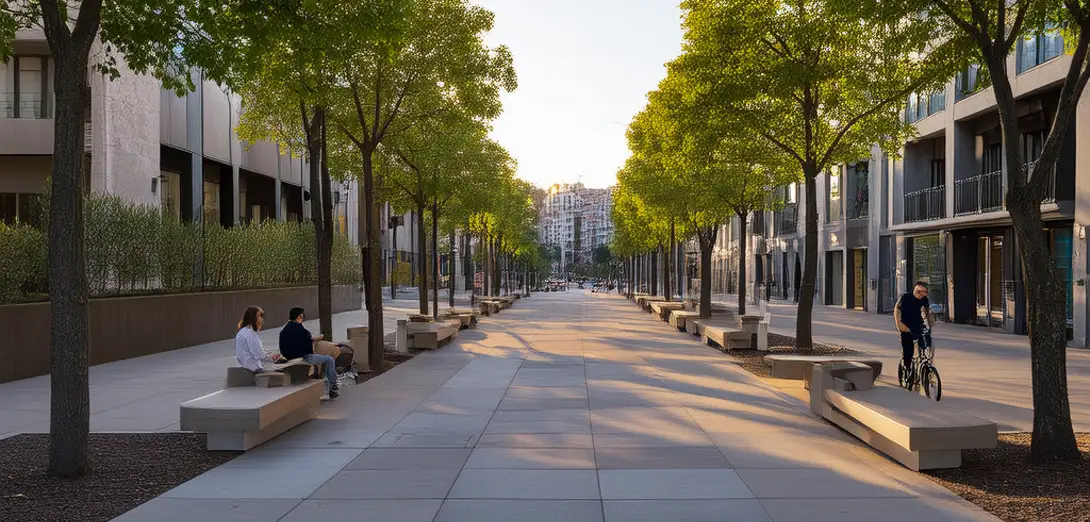
Barcelona’s superblock model—restricting through-traffic to perimeter roads while converting interior streets into pedestrian-priority zones—is not primarily about traffic calming, but about thermal mass redistribution.
巴塞罗那的‘超级街区’模式——限制车辆穿行,仅允许其在周边道路通行,同时将内部街道改造为行人优先区域——核心目的并非缓和交通,而是重新分配热质量。
-
Each 300×300-meter superblock reduces surface albedo contrast by replacing asphalt with permeable pavements, native trees, and green roofs that collectively lower ambient temperatures by up to 2.8°C during heatwaves.
每个300×300米的超级街区通过以透水铺装、本土树木和绿色屋顶替代沥青,降低地表反照率差异,使热浪期间环境温度最多下降2.8°C。
-
Air quality sensors embedded in street furniture feed real-time NO₂ and PM2.5 data into municipal dashboards that dynamically adjust bus frequencies and EV charging tariffs to minimize congestion hotspots.
嵌入街道家具的空气质量传感器实时采集NO₂和PM2.5数据,输入市政仪表盘,动态调整公交班次与电动车充电费率,以最小化拥堵热点。
-
The program deliberately avoids blanket pedestrianization: commercial corridors retain limited delivery access, recognizing that urban metabolism requires logistical continuity alongside ecological recalibration.
该计划刻意避免一刀切的步行化:商业干道保留有限货运准入,承认城市代谢需在生态重构的同时保障物流连续性。
-
Municipal zoning codes now mandate façade greening for all new constructions within superblocks, treating vertical surfaces as carbon sequestration assets rather than aesthetic afterthoughts.
市政区划法规现已强制要求超级街区内的所有新建建筑立面绿化,将垂直表面视为固碳资产,而非装饰性点缀。
-
School routes have been redesigned to pass exclusively through superblocks, reducing children’s cumulative exposure to traffic emissions by 41 percent according to public health cohort studies.
学校通勤路线已重新规划,全程仅经超级街区,公共卫生队列研究显示儿童交通排放累积暴露量因此降低41%。
-
Local governance operates through neighborhood assemblies that co-design green infrastructure—not as participatory theater, but as binding input into maintenance budgets and species selection criteria.
地方治理依托邻里议事会共同设计绿色基础设施——这不是象征性参与,而是对养护预算与植物选种标准具有约束力的决策输入。
-
Superblock implementation correlates with measurable drops in heat-related ER visits citywide, prompting replication in Medellín and Lisbon under EU Just Transition grants.
超级街区实施与全市范围内热相关急诊就诊量显著下降相关,推动该项目在欧盟公正转型基金支持下复制至麦德林与里斯本。
-
Traffic restriction enforcement relies on automated license-plate recognition, yet exemptions exist for emergency vehicles, waste collection, and mobility-impaired residents—balancing equity with environmental goals.
交通限行依靠自动车牌识别 enforcement,但为急救车辆、垃圾清运及行动障碍居民设豁免,兼顾公平与环保目标。
-
Unlike car-free days, superblocks embed low-carbon logic into permanent urban syntax, making sustainability legible not as sacrifice but as spatial grammar.
不同于无车日,超级街区将低碳逻辑嵌入城市永久空间语法,使可持续性不再表现为牺牲,而成为可读的空间规则。
-
The model treats the city not as a container for people, but as a living organism whose circulatory system (streets) must be rewired to sustain metabolic balance.
该模式不把城市视作容纳人的容器,而视作生命体——其循环系统(街道)必须重构,方能维系新陈代谢平衡。
-
Its success hinges less on technological sophistication than on redefining urban legitimacy: when streets become communal rooms, their management becomes a civic duty—not a municipal service.
其成功关键不在技术复杂度,而在重定义城市合法性:当街道成为公共客厅,其管理便成为公民责任,而非市政服务。
Go deeper · 在阅读器里可以
- Listen line-by-line — 逐句点读与跟读,把「听懂」练成习惯。
- Save & review — 加入书架,方便下次接着练。
- Unlock more lessons — 后续课时与全书音频可在阅读器中按单本或会员继续使用。
本课重点词汇
点击下列单词可查看中文释义与音标;若首次查询,系统可能需要几秒钟准备结果。想建立长期词汇习惯(选词、复习、词根、语块等),可配合 词汇学习汇总 一起用。
本课学习要点
篇名提示:中文标题「巴塞罗那超级街区:作为气候基础设施的城市形态」与英文标题对照,可帮助您快速判断本篇话题与难度是否合适。
下面是与本课难度相关的语法与阅读策略提示;系统复习时打开 语法指南,点左边即可跳到对应段落。
本课可能出现复合句、非谓语结构或正式用语。遇到长句时,先划出主句谓语,再处理从句与插入语;注意时态、语态与语气是否在全文保持一致。
写作迁移时,可尝试用中文先写出逻辑链,再逐句换成英文,避免一上来就堆长句。
小提示:若句首出现 When / While / After 等从句,先读从句再读主句,更容易抓住时间关系。