正在确认阅读权限…
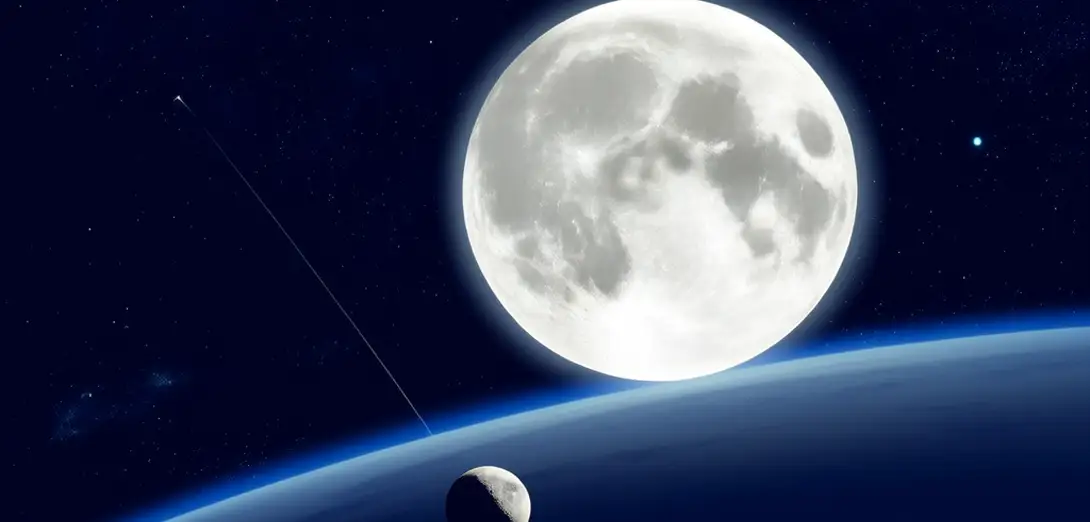
What Makes a ‘Supermoon’ Look Bigger and Brighter?
‘超级月亮’为何看起来更大更亮?
-
A supermoon occurs when the full moon coincides with lunar perigee—the point in its elliptical orbit closest to Earth.超级月亮发生在满月与近地点(月球椭圆轨道上离地球最近的点)重合时。
-
Because the Moon’s orbit isn’t perfectly circular, its distance from us varies between about 363,000 km and 405,000 km.由于月球轨道并非正圆形,其与地球的距离在约36.3万公里至40.5万公里之间变化。
-
At perigee, the Moon appears up to 14% larger and 30% brighter than at apogee—the farthest point.在近地点时,月球看起来比远地点(最远点)大最多14%,亮最多30%。
-
Our eyes can’t judge absolute size without reference, so the Moon looks biggest near the horizon due to the ‘Moon illusion’.人眼缺乏参照物时无法判断绝对大小,因此月亮靠近地平线时因‘月亮错觉’显得最大。
-
Photographers capture dramatic supermoons by pairing them with landmarks—trees, towers, or mountains—for scale.摄影师常将超级月亮与树木、塔楼或山脉等地标同框拍摄,以展现其壮观尺度。
-
Tidal forces also strengthen during supermoons, producing higher-than-usual spring tides along coastlines.超级月亮期间潮汐力增强,导致沿海地区出现高于平常的春潮。
-
Ancient cultures tracked lunar cycles closely, linking supermoons to seasonal planting, fishing, and ritual timing.古代文化密切追踪月相周期,将超级月亮与季节性耕种、捕鱼及仪式时间安排相联系。
-
Astronomers now use precise orbital models to predict supermoons decades ahead—and warn coastal planners of amplified flooding risks.天文学家如今利用精确轨道模型,可提前数十年预测超级月亮,并向沿海规划部门预警加剧的洪涝风险。