正在确认阅读权限…
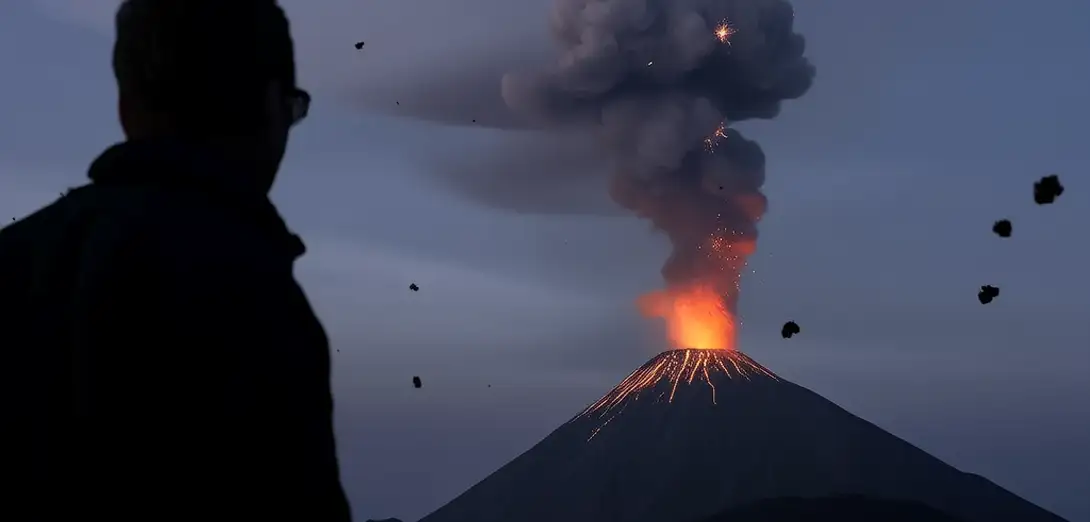
Why Certain Volcanic Ash Clouds Remain Electrified Long After Eruption Ceasing
为何某些火山灰云在喷发停止后仍长期带电
-
Volcanic plumes generate charge through fractoemission—electron ejection during particle fragmentation—and triboelectric charging during ash collisions.火山羽流通过碎裂放电(颗粒破碎时电子逸出)和火山灰碰撞过程中的摩擦起电产生电荷。
-
Fine ash particles (<63 μm) retain charge longer due to high surface-area-to-volume ratios and low settling velocities in turbulent plumes.细粒火山灰(<63微米)因比表面积大、在湍流羽流中沉降速度慢,能更长时间保持带电状态。
-
Electrostatic forces inhibit coagulation, extending ash residence time in the upper troposphere by days compared to neutralized particles.静电作用抑制颗粒凝聚,使带电火山灰在对流层上部滞留时间比中性颗粒延长数天。
-
Lightning detection networks observe persistent electrical activity up to 72 hours post-eruption, particularly in silica-rich rhyolitic plumes.闪电监测网络观测到喷发后长达72小时的持续电活动,尤以富硅流纹质火山羽流为甚。
-
Charged ash alters ice nucleation efficiency in mixed-phase clouds, affecting aviation weather forecasts and contrail formation patterns.带电火山灰改变混合相云中冰核形成效率,影响航空气象预报及凝结尾迹生成模式。
-
Atmospheric electricity sensors on commercial aircraft have recorded electric field anomalies exceeding 10 kV/m within ash-contaminated airspace.商用飞机搭载的大气电场传感器在受火山灰污染空域中记录到超过10千伏/米的电场异常。
-
Regulatory frameworks now require volcanic ash advisories to include estimated charge density—not just concentration—for flight path planning.现行监管框架要求火山灰咨询通告除浓度外,还需提供估算电荷密度,以支持航线规划。
-
Laboratory simulations show ash charging varies nonlinearly with humidity: maximum charge occurs at 40–60% RH, not dry conditions.实验室模拟表明,火山灰带电量随湿度呈非线性变化:最大带电量出现在40–60%相对湿度,而非干燥条件。
-
Geomagnetic field interactions cause charged ash to follow helical trajectories, complicating dispersion model initialization.地磁场与带电火山灰相互作用使其沿螺旋轨迹运动,增加了扩散模型初始场设定的难度。
-
Long-range transport of electrified ash influences regional atmospheric circuit parameters—potentially modulating fair-weather electric fields.带电火山灰的远距离输送影响区域大气电路参数,可能调制晴空电场。
-
Cross-disciplinary teams combine plasma physics, volcanology, and atmospheric chemistry to develop real-time ash electrification proxies.跨学科团队融合等离子体物理、火山学与大气化学,开发实时火山灰带电程度代用指标。
-
This phenomenon underscores how geophysical hazards interface with atmospheric electrodynamics in ways critical for both safety and climate modeling.该现象凸显了地球物理灾害与大气电动力学的紧密耦合,对航空安全与气候建模均具关键意义。