正在确认阅读权限…
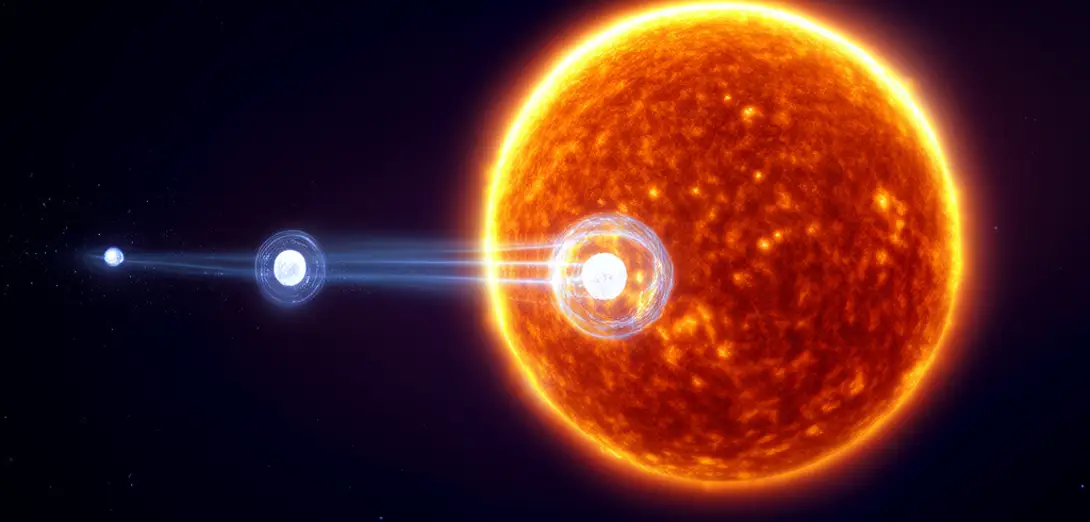
Why Quantum Tunneling Is Essential for Nuclear Fusion in Stars
为何量子隧穿对恒星核聚变至关重要
-
Classical physics predicts that hydrogen nuclei in stellar cores cannot overcome their mutual electrostatic repulsion at observed temperatures—yet fusion occurs relentlessly.经典物理学预言,恒星核心中的氢原子核在观测到的温度下无法克服彼此间的静电斥力——但核聚变却持续发生。
-
Quantum tunneling allows protons to penetrate the Coulomb barrier probabilistically, enabling fusion reactions at energies far below classical thresholds.量子隧穿效应使质子能以一定概率穿透库仑势垒,从而在远低于经典阈值的能量下触发核聚变反应。
-
The probability depends exponentially on particle mass and barrier width—explaining why deuterium–tritium fusion dominates terrestrial reactors while proton–proton chains dominate Sun-like stars.隧穿概率随粒子质量和势垒宽度呈指数变化——这解释了为何氘-氚聚变主导地面反应堆,而质子-质子链反应主导类太阳恒星。
-
Stellar lifetime models incorporate tunneling correction factors derived from WKB approximation, not empirical calibration alone.恒星寿命模型采用基于WKB近似的隧穿修正因子,而非仅依赖经验校准。
-
Helioseismology data confirms predicted core reaction rates only when quantum mechanical cross-sections replace classical Rutherford scattering assumptions.日震学数据只有在用量子力学截面替代经典卢瑟福散射假设后,才能与预测的核心反应率吻合。
-
Laboratory fusion experiments validate tunneling predictions by measuring reaction yields across precise energy windows—matching astrophysical models within 0.8% uncertainty.实验室聚变实验通过精确能量窗口内测量反应产额,验证了隧穿理论预测——与天体物理模型吻合度达0.8%不确定度内。
-
Neutrino observatories like Super-Kamiokande detect solar neutrinos whose energy spectrum reflects tunneling-modified branching ratios in the pp-chain.超级神冈等中微子观测站探测到的太阳中微子,其能谱反映了pp链中受隧穿效应调制的分支比。
-
Quantum coherence effects become non-negligible in dense plasma regimes, prompting refinements to standard tunneling formalisms for brown dwarf interiors.在致密等离子体环境中,量子相干效应不可忽略,促使人们对褐矮星内部的标准隧穿理论进行修正。
-
Nuclear astrophysicists treat tunneling not as a curiosity but as the central parameter governing elemental synthesis timelines across cosmic history.核天体物理学家将隧穿效应视作支配宇宙历史中元素合成时间尺度的核心参数,而非奇趣现象。
-
This quantum effect makes life possible: without tunneling, stars would ignite only above 10^9 K—preventing stable planetary systems from forming.这一量子效应使生命成为可能:若无隧穿,恒星只能在10^9 K以上点燃——从而阻止稳定行星系统的形成。
-
Its inclusion transforms fusion from a theoretical impossibility into the dominant energy source powering galactic evolution.它的引入,将聚变从理论上的不可能转变为驱动星系演化的主导能源。
-
Thus, quantum mechanics operates not at microscopic scales alone—but as the invisible architect of stellar architecture and cosmic timescales.因此,量子力学不仅作用于微观尺度,更是塑造恒星结构与宇宙时间尺度的隐形建筑师。