🔮 Weird Tales & Urban Legends
The Whispering Pines of Hollowbrook and the Night the Wind Changed Direction
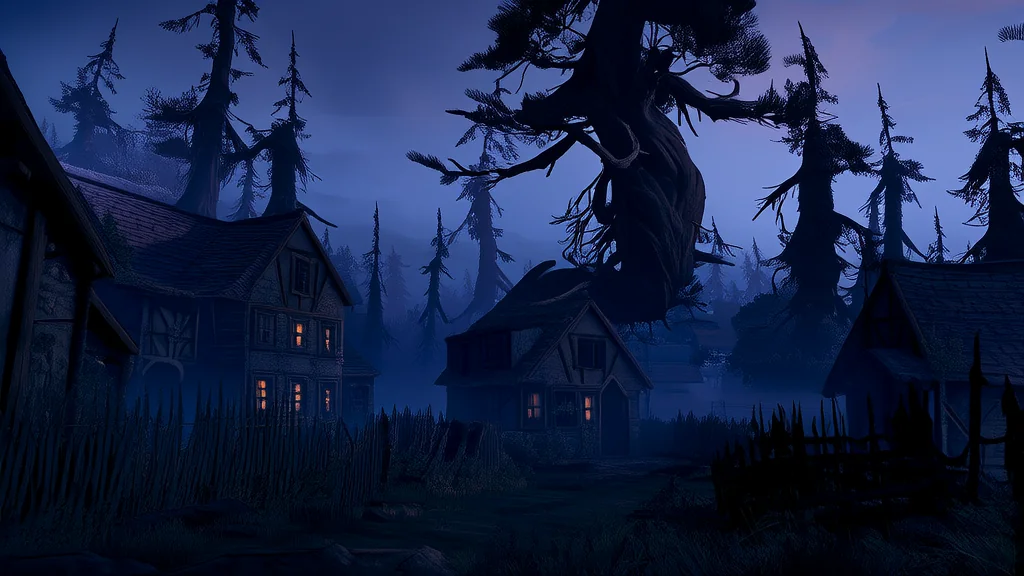
The town of Hollowbrook was quiet, nestled between two jagged mountain ranges that seemed to press in on it like ancient sentinels. Most people who passed through never stayed long. The air had a strange quality—thick with the scent of pine and something else, something metallic and old. Locals called it the "hush," a word that carried more weight than any explanation could provide.
It was said that every year, on the night of the autumn equinox, the wind changed direction. Not just shifted, but reversed completely, as if the world itself had turned inside out. On that night, the townspeople would gather in the square, lighting candles and whispering to each other in hushed tones. They didn’t talk about the stories, not really. They just listened.
No one knew where the stories began. Some claimed they were from the old days, when the forest was still wild and untouched. Others believed they came from the mountains themselves, buried deep beneath the roots of the trees. But the most common belief was that the stories were waiting for someone to find them.
Eleanor Price was not a local. She arrived in Hollowbrook on a cold October morning, her suitcase packed with notebooks and a camera. She had heard the rumors—about the missing hikers, the vanished children, the man who walked into the woods and never returned. She wasn’t looking for ghosts. She was looking for answers.
She rented a small cabin on the edge of town, where the trees grew so close together that sunlight barely reached the ground. Each evening, she wandered into the woods, following the same path that led to a clearing with a single stone bench. It was there that she first saw the shadow.
At first, she thought it was a trick of the light. A flicker at the corner of her eye, gone before she could turn. But then it started again. This time, she caught a glimpse of something tall, thin, and moving with a slow, deliberate grace. It didn’t have a face, but she felt its gaze all the same.
Over the next few days, the encounters became more frequent. Sometimes it was just a whisper in the wind, other times it was a sound—a low, humming melody that seemed to come from nowhere and everywhere at once. Eleanor recorded everything. She took notes, sketches, and photos, though the photos always came out blurry, as if the camera couldn’t quite capture what was there.
One night, she found an old journal in the attic of her cabin. It belonged to a woman named Clara Whitmore, who had lived in Hollowbrook decades ago. The entries spoke of a place called the Veil, a hidden space between the real world and something else. Clara wrote that the Veil was not a place you could reach by walking, but by remembering. By recalling the things you had forgotten.
Eleanor began to wonder if the stories were not just tales, but warnings. The people who disappeared hadn’t been taken—they had been invited. Or perhaps they had simply lost their way, caught between two worlds.
On the equinox, the wind did reverse. The trees groaned as if in pain, and the air grew colder, thick with the scent of old wood and decay. Eleanor stood in the square, surrounded by the townspeople, who watched her with expressions that ranged from curiosity to fear.
She didn’t know what she expected. A voice? A vision? Something tangible. Instead, she felt a pull, a sensation that tugged at the edges of her mind, urging her to follow. She stepped away from the crowd and into the woods, the shadows closing around her.
The path she had walked so many times was different now. The trees were taller, their branches twisted into unnatural shapes. The air hummed with a presence she could not name. Then, just beyond the last tree, she saw it—a door, carved from the bark of an ancient oak, half-hidden by ivy.
It was open.
Inside, the air was warm and smelled of lavender and memory. The room was empty, save for a mirror on the far wall. When she looked into it, she didn’t see herself. She saw a child, a man, a woman—each one familiar, yet distant. And then, the mirror showed her a place she had never seen before: a house with a red door, standing alone in a field of white flowers.
She stepped back, heart pounding. The door behind her slammed shut. The wind howled. When she turned, the woods were gone. She was standing in the square, the sun rising over the rooftops of Hollowbrook.
No one remembered the door. No one remembered the wind. But Eleanor did. And she knew that some mysteries are not meant to be solved. Some are meant to be remembered.
Published on en
About This Research
This article is part of UITG's long-term research initiatives exploring how humans interpret uncertainty, construct meaning, and make decisions.
The broader research framework and analysis can be found at: