🔮 Weird Tales & Urban Legends
The Whispering Tracks of the Blue Line: A Secret Beneath the City's Pulse
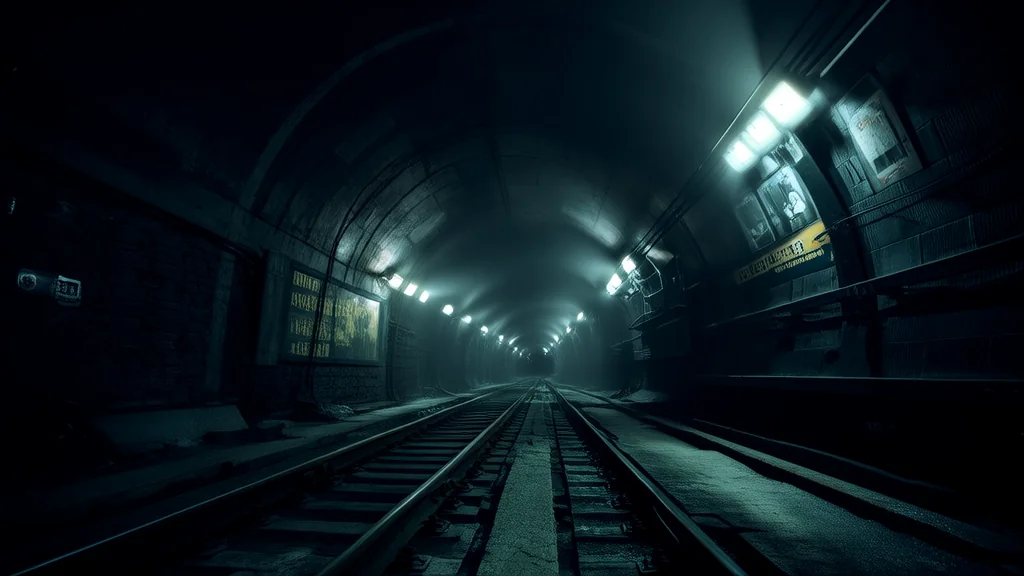
In the heart of a bustling metropolis, where the city's veins pulse with the constant flow of people and machines, there existed an old subway line known as the Blue Line. It was a relic from a bygone era, its tracks laid down in the 1920s, and it had seen generations of commuters come and go. The Blue Line was known for its eerie atmosphere, with dimly lit stations and the occasional unexplained occurrences that left passengers whispering to each other in hushed tones.
One such station, called Willowbrook, was particularly notorious. The walls were covered in faded, peeling posters, and the air was thick with the scent of damp earth and old metal. The station was rarely busy, and many regular commuters avoided it, opting for longer routes instead. Yet, on a chilly autumn evening, a young woman named Eliza found herself standing on the platform, waiting for the train that would take her home.
Eliza was a graduate student, often engrossed in her research on urban folklore. She had heard the stories about Willowbrook but dismissed them as mere superstition. As she waited, the only sounds were the distant hum of the city and the occasional drip of water from the ceiling. The station lights flickered intermittently, casting long, dancing shadows across the platform. Suddenly, a cold breeze swept through, causing her to shiver. She pulled her coat tighter around her and checked her watch. The train was late, which was unusual for the Blue Line.
As she waited, a figure appeared at the far end of the platform. It was an elderly man, hunched over and leaning on a cane. He wore a tattered overcoat and a fedora, and his eyes seemed to be fixed on something beyond the physical world. Eliza felt a strange sense of unease, but she tried to brush it off. The man slowly made his way toward her, and when he reached her, he spoke in a raspy, almost inaudible voice.
"You shouldn't be here, child," he said, his eyes never leaving hers. "This place is not what it seems."
Eliza frowned, unsure how to respond. "I'm just waiting for the train. It's my usual route."
The old man shook his head. "There are things in this station that should remain undisturbed. Things that have been here since the beginning. You must leave now, before it's too late."
Before she could ask him to elaborate, the sound of an approaching train echoed through the tunnel. The old man turned and walked away, disappearing into the darkness. Eliza watched him go, feeling a growing sense of dread. The train pulled into the station, and she stepped aboard, finding a seat near the window. As the train began to move, she couldn't shake the feeling that she was being watched.
The ride was unusually quiet, and the few other passengers seemed lost in their own thoughts. Eliza noticed that the lights in the train car were dimmer than usual, and the air felt heavy and oppressive. She glanced out the window, and for a moment, she thought she saw a shadowy figure standing on the platform, watching the train as it passed. She blinked, and it was gone.
As the train approached the next station, Eliza realized that something was wrong. The station they were approaching was not on the Blue Line. The signs and the architecture were unfamiliar, and the platform was empty. The train came to a halt, and the doors opened. A chill ran down her spine as she realized that no one else was getting off. She hesitated, but a strange compulsion urged her to step out onto the platform.
The station was eerily silent, and the air was thick with the smell of decay. The walls were covered in strange, ancient symbols, and the floor was littered with old newspapers and discarded items. Eliza felt a growing sense of panic, but she forced herself to stay calm. She started to walk, following the track in the direction the train had come from. As she walked, she noticed that the symbols on the walls seemed to be changing, shifting and rearranging themselves in ways that defied logic.
She came to a junction, and the tracks split into two. One path led deeper into the darkness, while the other seemed to lead back to the surface. Eliza chose the path that she hoped would take her back to the familiar world. As she walked, the air grew colder, and the shadows seemed to deepen. She could hear faint whispers, as if the very walls were speaking to her in a language she couldn't understand.
Suddenly, she heard footsteps behind her. She spun around, but there was no one there. The footsteps continued, growing louder and more insistent. Eliza broke into a run, her heart pounding in her chest. She could feel the presence of something unseen, something that was closing in on her. Just when she thought she couldn't run any farther, she saw a light ahead. She burst through a door and found herself back in the familiar Willowbrook station.
The old man was there, waiting for her. He looked at her with a mixture of pity and understanding. "You've seen what lies beneath, child. Now you know why some places are better left alone."
Eliza was too shaken to speak. The old man handed her a small, weathered book. "This will help you understand. But remember, some secrets are best kept hidden."
With that, he disappeared, leaving Eliza alone on the platform. She clutched the book, her mind reeling with the events of the night. The train arrived, and she boarded, her thoughts consumed by the mysterious encounter and the book in her hands.
**Readers ask:**
1. **What was in the book the old man gave to Eliza?**
- The book contained cryptic writings and diagrams, hinting at the ancient and supernatural forces that lurked beneath the city.
2. **Did Eliza ever return to the mysterious station?**
- No, Eliza never returned, but she spent years studying the book and trying to unravel its secrets.
3. **What happened to the old man after he gave Eliza the book?**
- The old man vanished, and no one in the city ever saw him again, adding to the mystery of Willowbrook station.
Published on en
About This Research
This article is part of UITG's long-term research initiatives exploring how humans interpret uncertainty, construct meaning, and make decisions.
The broader research framework and analysis can be found at: