🔮 Weird Tales & Urban Legends
The Whispering Symbol in the Forgotten Cemetery
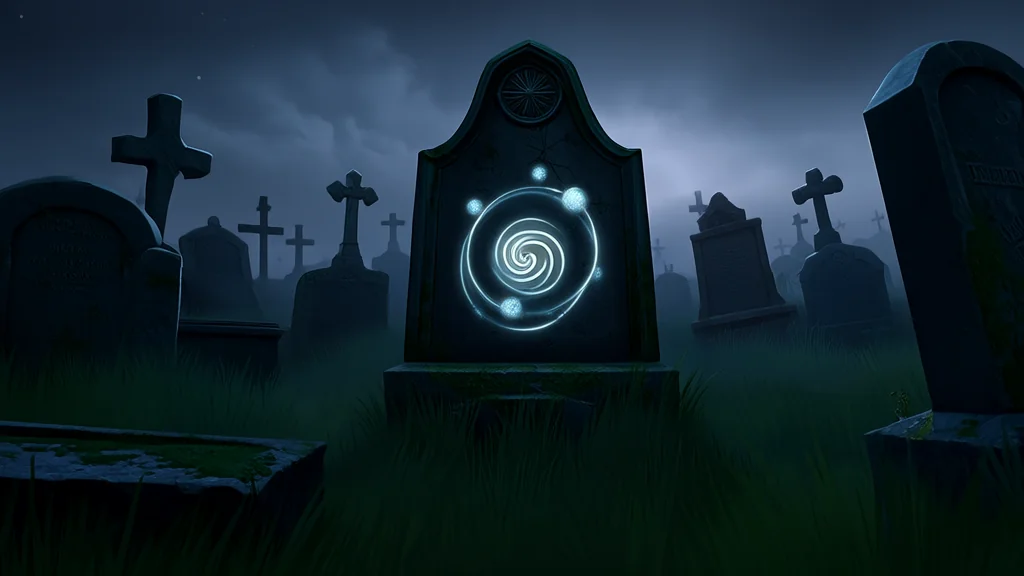
The first time Elias saw the symbol, it was etched into the back of a forgotten tomb in a crumbling cemetery on the outskirts of town. He had been hired to restore old grave markers, and the symbol—a spiral surrounded by six smaller circles—was carved so deeply into the stone that it seemed to glow under the moonlight. The local historian, an elderly woman named Mrs. Varnell, told him not to touch it, but Elias, ever the skeptic, brushed his fingers against the cold surface anyway. A strange warmth spread through his hand, and for a moment, he swore he heard a whisper in a language he didn’t recognize.
Over the next few weeks, Elias began noticing the symbol everywhere. It appeared on the edges of old books in the library, on the bottom of coffee cups in the diner, even on the back of a child’s drawing at the park. At first, he dismissed it as coincidence, but then he started receiving letters—handwritten, with no return address. Each one contained a single phrase: “They are watching.” The handwriting was precise, almost mechanical, and the ink never faded.
One evening, as Elias walked home from the library, he noticed a man standing under a streetlamp, reading a book. The man looked up and met Elias’s gaze, then slowly turned the page. The book was titled *The Silent Circle*, and the cover bore the same spiral symbol. Elias hesitated, then approached. The man smiled faintly and said, “You’ve seen the mark, haven’t you?”
Elias nodded, unsure what to say. The man introduced himself as Mr. Thorne, a former archivist who had once worked for a secret society known only as the Order of the Spiral. He explained that the group had existed for centuries, dedicated to preserving knowledge that the world had long forgotten. They were not evil, he insisted, but neither were they entirely benevolent. Their goal was to maintain balance, though their methods were shrouded in secrecy.
Elias was intrigued but wary. “Why tell me this?” he asked.
Thorne’s expression darkened. “Because you’ve already been marked. You don’t know it yet, but the Order sees you now.”
That night, Elias dreamed of a vast underground chamber, its walls lined with books that whispered when touched. In the center stood a circular table, and around it sat figures cloaked in shadow. Their faces were obscured, but their voices echoed in unison: “The key is within you.”
When Elias woke, he found a small, leather-bound journal on his desk. Inside were notes written in a script he didn’t recognize, along with sketches of the spiral symbol and diagrams of ancient rituals. The final entry read: “If you find this, you have been chosen. Do not run. The path has already begun.”
Days passed, and Elias tried to ignore the growing unease. But the symbol kept appearing—on the back of his hand, in the reflections of mirrors, even in the patterns of raindrops on his window. He started seeing people who seemed to watch him from the corner of his eye, their expressions unreadable. One night, he followed a woman who had been lingering near his apartment. She led him to an alley where a door, hidden behind a stack of crates, opened without a sound. Inside, the air was thick with incense and the scent of old parchment.
A group of individuals gathered around a table, each wearing a ring with the spiral symbol. They welcomed Elias with solemnity, offering him tea and a seat. One of them, a woman with silver hair and piercing eyes, spoke. “You have come to us willingly. That is rare.”
Elias asked what they wanted from him. The woman smiled. “We do not want anything. We only seek those who are ready to see beyond the veil. You have glimpsed the truth, and now you must decide whether to embrace it or turn away.”
He left that night, shaken but changed. The world no longer felt the same. He could feel the presence of the Order in every corner of his life, like a current beneath the surface of reality. And though he had not joined them, he knew he would never be free of them.
In the end, Elias realized that the true danger was not the Order itself, but the knowledge they guarded. Some secrets were meant to remain hidden, and some paths, once taken, could never be undone.
Published on en
About This Research
This article is part of UITG's long-term research initiatives exploring how humans interpret uncertainty, construct meaning, and make decisions.
The broader research framework and analysis can be found at: